Basmati Rice: The Complete Buying Guide for India’s Most Famous Grain
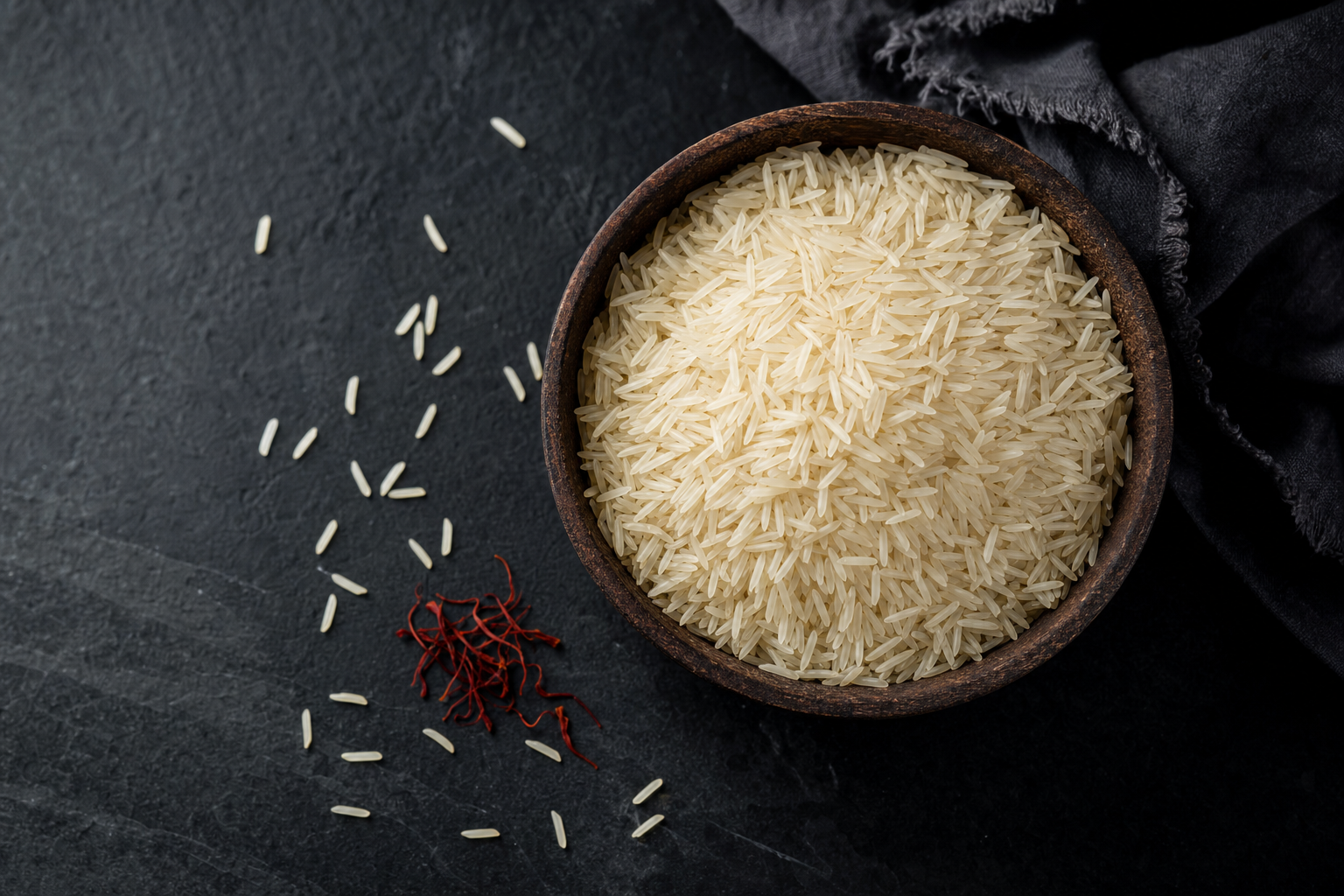
There is a particular moment when you lift the lid off a pot of properly cooked aged basmati. The steam carries something between toasted nuts and fresh bread, a scent that announces the meal before a single spoon is raised. That fragrance is not marketing language. It is the signature of a single aroma compound, shaped by centuries of cultivation in one very specific corner of the world.
This guide covers what you need to buy basmati with confidence: the science behind its aroma and grain behaviour, the key commercial varieties, why ageing matters, how to detect inferior product, and how to cook it correctly.
A Grain With Roots in the Himalayas
The word basmati is widely understood to derive from the Sanskrit vaas (fragrance) and matup (possessing), the “fragrance-possessing” grain. According to a Nature India feature on basmati’s history, traditional basmati varieties have been cultivated in the Indo-Gangetic plains for many centuries, prized in royal kitchens long before reaching export markets.
What makes basmati genuinely different from other long-grain rices is inseparable from where it grows. The agro-climatic conditions of the Himalayan foothills, cool nights, specific soil mineral profiles, low humidity during grain-filling, activate the gene responsible for its signature aroma. Traditional basmati varieties are also photoperiod-sensitive: they will not flower before a fixed calendar point (typically early October), ensuring aromatic expression is fully triggered by the correct environmental cues.
The GI Tag and Its Seven States
India’s basmati is now a protected product under Geographical Indication (GI) law. APEDA, the registered proprietor of the GI, received the certificate of registration on 15 February 2016 from the GI Registry in Chennai. Under that certification, only rice grown across 77 designated districts within seven northern states may legally be labelled basmati: Punjab, Haryana, Uttar Pradesh (western districts), Uttarakhand, Himachal Pradesh, Delhi, and Jammu & Kashmir. Any packet claiming to be Indian basmati that sources grain from outside these states is, by definition, mislabelled.
The commercial stakes are considerable. India exported over 6 million metric tonnes of basmati in 2024–25, valued at approximately USD 5.94 billion, one of the country’s most valuable agricultural export commodities.
The Science of What Makes Basmati, Basmati
Understanding what you are paying for begins with three properties: grain elongation, aroma chemistry, and cooking behaviour.
Grain Elongation
Raw basmati has a characteristically long, slender grain, but the more important measure is what happens during cooking. APEDA’s quality standard requires that a basmati grain elongate to at least twice its raw length upon cooking. Premium varieties significantly exceed that benchmark, Pusa Basmati 1121, for instance, holds a record cooked kernel length of 21.5 mm, representing an elongation of 2.7 times the raw grain. Crucially, the grain elongates almost entirely along its length, with minimal increase in breadth. The result is an improbably long, separate, non-sticky grain on the plate, the visual hallmark that separates premium basmati from long-grain imposters.
The Aroma Compound: 2-Acetyl-1-Pyrroline
The aroma is not a vague, romantic notion. It is a specific organic compound: 2-acetyl-1-pyrroline (2-AP). This compound is responsible for the pleasant, popcorn-like aroma that distinguishes basmati and other scented rice varieties, and its production is governed primarily by a mutation in the BADH2 gene (betaine aldehyde dehydrogenase 2). Pusa Basmati 1121 carries the characteristic 8 bp deletion in the Badh2 gene confirmed by whole-genome re-sequencing, which is the molecular fingerprint that distinguishes genuinely aromatic varieties from non-aromatic long-grain rice.
The concentration of 2-AP also responds to storage: aged basmati develops a richer fragrance than freshly milled grain, one of the reasons the trade prizes properly matured rice.
The Double-Bend Cooking Behaviour
Basmati grains display a distinctive curve when they elongate in hot water, a gentle arc that straightens as the grain cooks through. Experienced cooks know to look for this arching behaviour during boiling as a sign of genuine, high-quality grain. Adulterated or non-basmati long-grain rice will remain comparatively straight.
A Field Guide to Indian Basmati Varieties
India’s ICAR-IARI (Indian Agricultural Research Institute) in New Delhi, the Pusa Institute, has been the primary breeding centre for modern basmati varieties. Understanding the differences between the major types helps you choose the right grain for the right purpose.
Pusa Basmati 1121
Released in 2003, PB 1121 is arguably the grain that transformed the global basmati trade. Its raw grain length averages 9 mm, and it achieves a cooked length of up to 21.5 mm, a world record for kernel elongation. It produces fluffy, separate, non-sticky grains with strong aroma and is today the dominant variety in Indian exports. PB 1121 is the grain behind most premium biryani and pulao preparations where visual drama and separation matter.
Pusa Basmati 1509
An early-maturing, semi-dwarf variety, PB 1509 achieves a cooked kernel length of 18.2 mm with excellent cooking quality. Its shorter growing season has made it commercially attractive for farmers and millers alike. For everyday cooking where grain length is secondary to texture and flavour, 1509 is the practical choice.
Pusa Basmati 1718 and 1885
PB 1718 adds bacterial blight resistance via marker-assisted breeding (genes xa13 and Xa21) while retaining premium grain and cooking quality. PB 1885 is a near-isogenic line of PB 1121 with resistance to both bacterial blight and blast, reducing chemical inputs during cultivation. Both deliver eating quality comparable to 1121 with improved field performance.
Traditional Dehraduni Basmati
Before the modern Pusa breeding programme, Dehradun in Uttarakhand was considered the spiritual home of India’s finest basmati. The Dehraduni varieties are renowned for an especially intense popcorn-like aroma, a product of the specific microclimate of the Doon Valley. Their grains are somewhat shorter than 1121 but the flavour profile is considered more complex and persistent. Traditional Dehraduni basmati has become increasingly rare as commercial varieties have displaced it, which makes genuinely sourced Dehraduni grain one of the more prized products in the premium segment.
Why Ageing Matters
Freshly milled basmati retains significant moisture in the grain, typically in the range of 12–14% moisture content. At this stage, the grain is prone to becoming sticky and clumping during cooking, because excess water interferes with the starch structure and limits elongation.
Proper ageing, storing milled or paddy basmati for 12 to 24 months under controlled conditions, addresses this biochemically. Moisture content falls naturally, starch molecules restructure to reduce adhesiveness, and amylose-lipid complexes form within the grain. The practical result: aged basmati cooks to a markedly fluffier, non-sticky texture with enhanced elongation and a richer aroma than fresh-milled rice.
Research on rice ageing kinetics confirms that storage increases water uptake during cooking, volume expansion, hardness, and reduced adhesiveness, all desirable traits for the long, separate grain basmati buyers seek. These biochemical changes cannot be shortcut.
When buying, look for “aged” or “matured” on the packaging with a harvest or milling year. A gap of 12–24 months between harvest and purchase is the reliable indicator.
How to Identify Premium Basmati at Home
You do not need a laboratory. These practical tests will reveal a great deal about the grain in front of you.
The length test. Pour a small quantity of dry grains onto a white plate. Extra-long grain basmati (PB 1121 or equivalent) should measure close to 8–9 mm in the raw state, roughly the length of a standard pen cap is 8 mm. Any grain significantly shorter than this is either a lower-grade variety or adulterated.
The fragrance test. Take a small pinch of dry grains and rub them briskly between your palms for a few seconds. Genuine premium basmati will release a distinct, warm, nutty-popcorn aroma even before cooking. Little or no fragrance suggests poor variety selection, very fresh (unaged) grain, or adulteration.
The cooking test. Soak a tablespoon of grains for 20–30 minutes, then boil briefly. Measure or visually assess the cooked grain against the raw: it should more than double in length and arch gently during cooking. The cooked grain should hold its shape, separate cleanly, and not clump. Stickiness or breakage is a sign of low quality or adulteration.
The uniformity test. Examine a handful of raw grains against a dark background. Genuine premium basmati should be remarkably uniform: consistent ivory-white colour, similar length, minimal broken grains, no discolouration. Mixed grain lengths or significant colour variation suggests blending.
Basmati vs. Jasmine vs. Sona Masoori: What to Use When
| Property | Basmati | Jasmine | Sona Masoori |
|---|---|---|---|
| Origin | Northern India (GI-protected) | Thailand / Southeast Asia | Andhra Pradesh, Telangana, Karnataka |
| Grain type | Extra-long, slender | Long, slightly fatter | Medium |
| Aroma compound | 2-acetyl-1-pyrroline (strong) | 2-acetyl-1-pyrroline (milder) | Minimal |
| Cooked texture | Fluffy, separate grains | Soft, slightly sticky | Soft, slightly sticky |
| Elongation | 2x–2.7x raw length | Minimal elongation | Minimal elongation |
| Glycemic index | Lower (higher amylose) | Moderate–high | Moderate |
| Best uses | Biryani, pulao, dum rice, jeera rice | Thai curries, congee, fried rice | Everyday dal-chawal, idli/dosa (partially) |
The differences are not about quality hierarchy, jasmine and sona masoori are excellent grains for their intended purposes. The choice is about whether the dish requires long, separate, aromatic grains (basmati’s domain) or a softer, more cohesive texture.
The Problem of Adulteration
Adulteration is a well-documented challenge in the basmati trade. Research published in the Journal of Food Science and Technology confirms that mixing non-basmati long-grain rice with genuine basmati is widespread, driven by the significant price premium basmati commands over non-basmati rice. The most common adulterant is Parmal rice, a non-basmati long-grain variety from Punjab and Haryana that superficially resembles basmati in colour and shape.
The tell-tale signs for the home buyer: inconsistent grain lengths in the same packet, weak or absent fragrance, poor elongation on cooking, and stickiness in the cooked grain. Brands carrying APEDA registration and traceability documentation offer the most reliable guarantee of purity.
Cooking Basmati Correctly
Even the finest aged basmati will underperform if the technique is off. Follow this sequence.
1. Rinse thoroughly. Rinse the rice under cold water, three to four changes, until the water runs mostly clear. This removes surface starch that would otherwise cause clumping.
2. Soak for 30 minutes. Soaking allows the grain to hydrate evenly before heat is applied, reducing cooking time and, importantly, helping preserve more of the volatile 2-AP aroma compound by shortening exposure to boiling water. Do not skip this step with premium aged grain.
3. Water ratio. For the absorption method, use a ratio of 1 cup rice to 1.5 cups water for well-aged basmati. Freshly milled grain may require slightly more. Add a generous pinch of salt.
4. The dum/draining choice. Two classical techniques: - Absorption (dum): Bring to a gentle boil, reduce to the lowest heat, seal tightly (a cloth under the lid traps steam), and cook undisturbed for 12–15 minutes. Rest off heat for 5 minutes, then fluff with a fork. - Draining method: Boil in abundant salted water for 8–10 minutes until about 80% cooked, then drain. Return to the pot, seal, and steam on low heat for 5 minutes. Preferred for biryani: the cleanest, most separate grains result.
5. Never stir during cooking. Agitation breaks elongated grains and releases surface starch.
Storing Basmati at Home
Once opened, transfer basmati to an airtight container. Glass or food-grade stainless steel preferred over plastic. Store in a cool, dark, dry place away from sunlight and heat sources. The 2-AP aroma compound is volatile: exposure to heat and moisture accelerates its loss, making a consistent pantry environment non-negotiable.
Avoid storing near strongly scented items, as rice readily absorbs ambient odours. Bay leaves or dried neem leaves in the container deter weevils naturally. Properly stored, premium white basmati retains quality for 12–18 months after purchase.
Key Takeaways
- Only rice from 7 designated Indian states qualifies for the GI-protected basmati label (APEDA, registered proprietor since February 2016).
- The signature aroma comes from 2-acetyl-1-pyrroline (2-AP), controlled by the BADH2 gene, present in genuine basmati, absent in non-aromatic long-grain substitutes.
- 12–24 months of ageing reduces moisture, restructures starch, and delivers the fluffy, elongated, separate grain that defines premium basmati.
- PB 1121 is the benchmark for grain length; PB 1509 excels for everyday use; Dehraduni varieties offer the most intense traditional aroma.
- At home: fragrance rub, length check, and cooking test are your three reliable quality indicators.
- Store in an airtight container, away from heat and strong odours.
Shop at Aplus Foods
Aplus Foods has been milling and sourcing premium grains from Nawanshahr, Punjab, in the heart of the GI-designated basmati belt, since 1958. Operating under FSSC 22000, US FDA, and HACCP certifications, every batch of basmati stocked through Aplus meets rigorous quality and traceability standards across our family of brands: Aplus, Nuts About You, and Healthy House. Explore the current selection of aged, certified basmati rice at store.aplus.food.
Premium pulses, dry fruits and more
Shop heritage Aplus Foods products. Free shipping above ₹999. FSSC 22000 · US FDA · HACCP certified.
Browse the Shop →