Millets (Shree Anna): India’s Complete Guide to 8 Types, Nutrition, and Kitchen Use
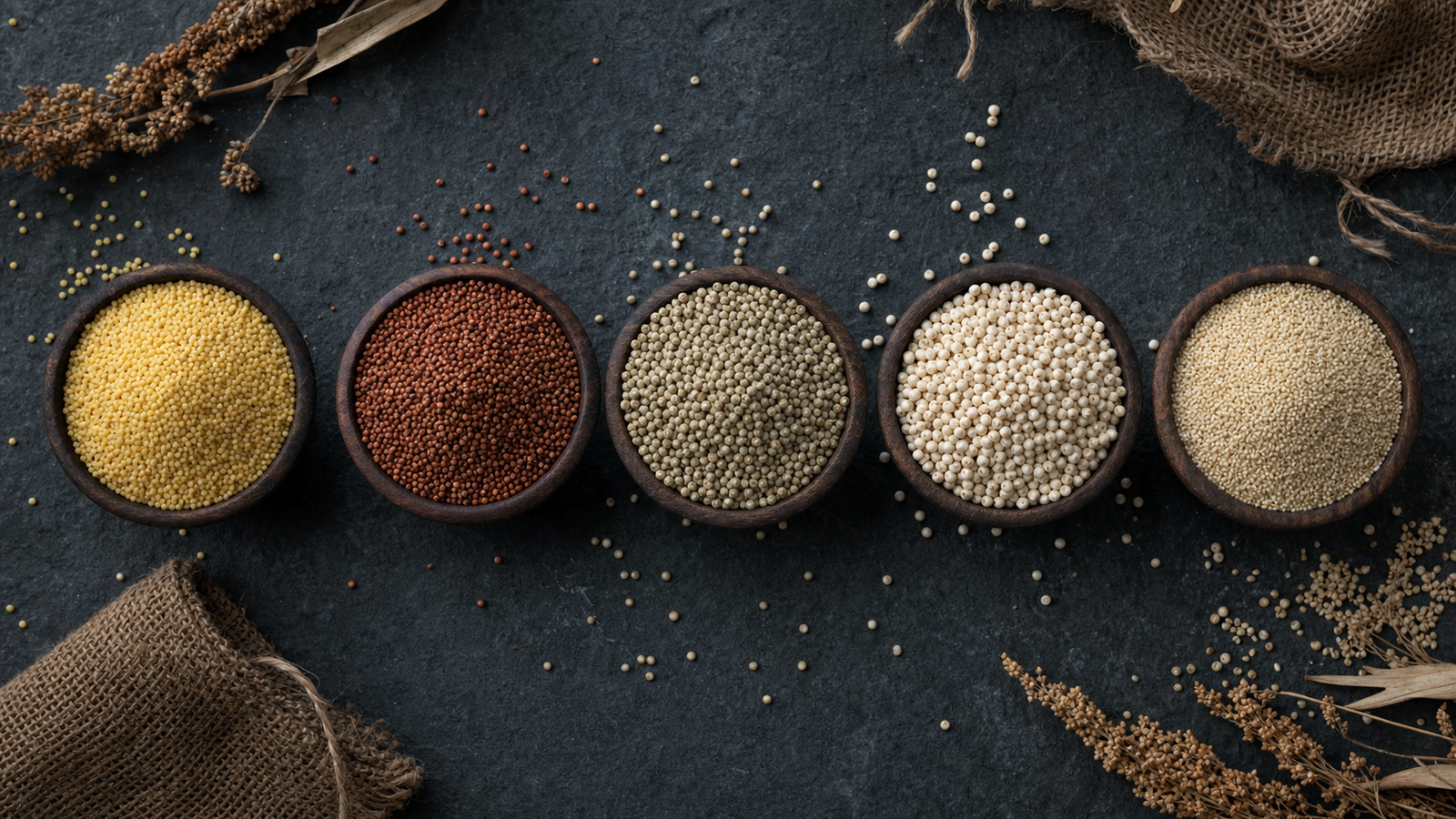
India has always known this. Long before the word “superfood” entered the global vocabulary, Indian farmers across Rajasthan, Karnataka, Maharashtra, Andhra Pradesh, and Jharkhand were growing a diverse portfolio of small, ancient grains that fed civilisations, withstood droughts, and nourished populations on nothing more than poor soil and minimal water. The world is only now catching up.
In 2021, at India’s proposal, the United Nations General Assembly declared 2023 the International Year of Millets (IYM). The resolution recognised millets’ critical contribution to food security, nutritional diversity, and climate-resilient agriculture. India led the charge, it is the world’s single largest millet producer, contributing 38.4% of global production as of 2023 (FAO), and branded its ancient grains with a term of profound respect: Shree Anna (the honoured grain).
This is the guide for every Indian household ready to bring Shree Anna back to the thali.
Why Millets, Why Now?
The story of millet’s decline in India is inseparable from the post-Green Revolution shift to wheat and rice. Policy incentives, procurement price structures, and the cultural prestige of polished white rice pushed coarser grains to the margins of the Indian diet, particularly in urban households.
The consequences of this displacement are visible in India’s nutrition data: micronutrient deficiencies in iron, calcium, and zinc are widespread, especially among women and children. Meanwhile, the glycaemic burden of a white rice-dominant diet has contributed to the diabetes and metabolic syndrome epidemic that now affects tens of millions of Indians.
Millets address both problems. They are naturally gluten-free, have a lower glycaemic index than polished rice or refined wheat, are richer in fibre, and contain meaningful concentrations of iron, calcium, magnesium, and zinc that their displaced counterparts do not. The ICAR-Indian Institute of Millets Research (IIMR), Hyderabad, the premier public research body for millet science in India, has established that millets have the lowest glycaemic indices among cereal grains and have documented benefits for diabetes, cardiovascular health, and anaemia control.
The FAO’s IYM 2023 Final Report confirmed a “multitude of stakeholders across the world” were reached with millets education, a global outreach of over 200 million people.
The 8 Key Millets for the Indian Kitchen
1. Foxtail Millet (Kangni / Thinai)
Botanical name: Setaria italica
One of the oldest cultivated crops in the world, foxtail millet is widely grown across Andhra Pradesh, Telangana, Karnataka, and Tamil Nadu. The small, yellow-gold grains have a mild, slightly sweet flavour. Per ICAR-IIMR nutrition data, foxtail millet provides 12.3g protein and 8g fibre per 100g, placing it among the higher-protein millets. It is an excellent source of B-vitamins, particularly thiamine and niacin, and its low glycaemic index makes it suited to blood sugar management.
Kitchen use: Kangni khichdi, foxtail millet upma, thinai pongal, rice replacement in daily meals.
2. Finger Millet (Ragi / Mandua)
Botanical name: Eleusine coracana
Ragi is the calcium champion of the millet family. With 344mg of calcium per 100g, nearly 10 times the calcium content of wheat and comparable to dairy, finger millet is exceptional for bone health, per ICAR-IIMR and the Frontiers in Nutrition review (PMC). Ragi is also rich in the amino acid tryptophan and natural antioxidants in its dark husk that contribute to anti-ageing properties.
Predominantly grown in Karnataka, Andhra Pradesh, Tamil Nadu, and Uttarakhand, ragi is the basis of ragi mudde (ragi balls), ragi roti, and ragi porridge, a classic infant and toddler food across south India. The dark brown colour can be off-putting to first-time users but disappears into flavour in sweet preparations.
Kitchen use: Ragi roti, ragi mudde, ragi porridge with jaggery, ragi cookies, ragi smoothie with banana and cocoa.
3. Pearl Millet (Bajra)
Botanical name: Pennisetum glaucum
The millet of Rajasthan, Gujarat, and Haryana, bajra is India’s most widely produced millet by volume. It is notably high in iron (16.9mg per 100g per IIMR data), among the highest of all cereal grains, making it critically important for addressing India’s iron-deficiency anaemia burden. Bajra is also the richest millet in total fat (3–8%), giving it a warming, calorie-dense quality that makes it ideal for winter consumption.
Traditional wisdom has always paired bajra with the winter months: bajra roti with ghee and jaggery is sustenance designed for cold-weather energy. Modern nutrition validates this: the iron, zinc, and B-vitamin content support immunity and energy metabolism through the cold season.
Kitchen use: Bajra roti (bhakri), bajra khichdi, bajra kheer, raab (a traditional Rajasthani drink).
4. Sorghum (Jowar)
Botanical name: Sorghum bicolor
Jowar is the staple grain of Maharashtra, Karnataka, and Andhra Pradesh, and is one of the world’s most important food crops. Per 100g, it provides 10g protein, 4g fibre, and 2.6mg iron (IIMR). It is gluten-free, has a moderate glycaemic index lower than white rice, and is easily digestible. The large, round white or cream-coloured grains are mild in flavour and highly versatile.
Jowar has gained significant traction in health-conscious urban kitchens as a wheat alternative for flatbreads. Jowar bhakri (thick flatbread) with zunka (spiced chickpea flour preparation) is a classical Maharashtrian combination that delivers excellent protein and fibre together.
Kitchen use: Jowar bhakri, jowar dhokla, jowar flour chapati, jowar dosa, jowar porridge.
5. Little Millet (Kutki / Same)
Botanical name: Panicum sumatrense
One of the lesser-known but exceptionally nutritious millets, little millet provides 9.3mg of iron per 100g, making it one of the most iron-rich millets available, per IIMR data. It is small and white-cream in appearance, mild in flavour, and cooks faster than most millets. Popular in the tribal belt of Chhattisgarh, Jharkhand, and parts of Odisha and the Deccan, kutki is also recognised under the government’s Shree Anna promotion programme.
Kitchen use: Little millet khichdi, sama rice (also used as a vrat/fasting grain in some regions), little millet pongal, rice substitute in everyday meals.
6. Kodo Millet (Kodo / Varagu)
Botanical name: Paspalum scrobiculatum
Kodo millet is among the highest in fibre, 9g dietary fibre per 100g, per IIMR. The grain is small and reddish-brown, with a slightly earthy, nutty flavour that is distinct among millets. It is particularly suited for diabetes management due to its high fibre and moderate glycaemic response. Grown primarily in the Deccan plateau and tribal regions of central India, kodo has a long traditional history of use in Chhattisgarh cuisine.
Kitchen use: Kodo millet dosa, kodo khichdi, kodo millet daliya (broken porridge), grain bowls.
7. Barnyard Millet (Sanwa / Udalu)
Botanical name: Echinochloa frumentacea
Barnyard millet has the highest fibre content of commonly cultivated millets, up to 10.1g fibre per 100g, and an impressive 15.2mg iron per 100g according to IIMR data. This makes it nutritionally superior for both gut health and iron repletion. It is also a cooling grain, traditionally consumed in summer in many regions.
In some north Indian states, barnyard millet (samak) is used as the grain of choice during Navratri and other fasting observances, a beautiful intersection of tradition and nutrition.
Kitchen use: Samak rice (fasting rice), barnyard millet khichdi, samak kheer, grain porridge.
8. Proso Millet (Cheena / Barri)
Botanical name: Panicum miliaceum
One of the oldest cultivated crops in human history, proso millet is the highest in protein among common millets, 12.5g per 100g per IIMR. The round, cream-coloured grains cook quickly and have a mild, neutral flavour that makes them extremely versatile. Proso’s protein profile includes essential amino acids, making it useful in plant-based diets seeking to diversify protein sources.
Kitchen use: Proso millet pulao, cheena khichdi, millet idli, grain salad base.
Millets vs Wheat and Rice: The Numbers
| Nutrient (per 100g) | Finger Millet | Foxtail Millet | Pearl Millet | Barnyard Millet | Rice (white) | Wheat |
|---|---|---|---|---|---|---|
| Protein (g) | 7.3 | 12.3 | 11.6 | 11.2 | 6.4 | 11.8 |
| Fibre (g) | 3.6 | 8.0 | 1.3 | 10.1 | 0.3 | 2.0 |
| Calcium (mg) | 344 | 31 | 42 | 11 | 2 | 29 |
| Iron (mg) | 3.9 | 2.8 | 16.9 | 15.2 | 0.6 | 3.9 |
Source: ICAR-IIMR, Hyderabad; Frontiers in Nutrition (PMC)
The data tells a compelling story: even the lowest-fibre millet (pearl millet) contains more than four times the fibre of white rice. Finger millet has nearly 170 times the calcium of white rice. Barnyard and pearl millets dwarf all cereals on iron. The PIB/Government of India Shree Anna report confirms millets are “superior to wheat and rice” in terms of nutritional quality.
Glycaemic Index: Why It Matters
Millets are naturally lower on the glycaemic index (GI) than refined wheat and white rice. A lower GI means a slower, more sustained rise in blood glucose after eating, important for the millions of Indians managing or at risk of type 2 diabetes. ICAR-IIMR’s research has specifically documented the anti-diabetic properties of millets and their role in reducing fasting blood glucose.
Simple Replacement Recipes
Millet Khichdi (One-Pot Comfort)
Use foxtail millet or little millet in place of rice in a standard khichdi: mix 1 part millet with ½ part masoor or moong dal, temper with ghee, jeera, hing, and turmeric, add double the water compared to rice, and cook covered for 18–20 minutes. The result is a khichdi with better fibre and a lower glycaemic impact than the rice version.
Ragi Roti
Combine 1 cup ragi flour with 2 tablespoons of finely chopped onion, green chilli, coriander, and a pinch of salt. Add warm water gradually to make a firm but pliable dough. Roll thin and cook on a dry tawa until small brown spots appear. Ragi roti with butter or ghee and a bowl of curd is a complete breakfast.
Jowar Dhokla
Replace besan with a blend of jowar flour (70%) and chickpea flour (30%) in a standard dhokla recipe. Ferment the batter overnight (the fermentation slightly reduces phytic acid and improves mineral absorption), steam, and temper with a standard mustard-curry leaf tadka. The result is a lighter, gluten-free dhokla with better mineral availability.
Why Milling and Dehulling Quality Matters
Millets have a seed coat (husk) that must be removed before cooking, the dehulling process. Here lies a critical quality distinction.
Over-processing millets, particularly aggressive polishing, strips away the bran layer along with most of the fibre, iron, and calcium that makes them nutritionally superior in the first place. A polished, white-coloured ragi or foxtail millet has a fraction of the nutritional value of its minimally processed counterpart.
Look for millets that are dehulled but not over-polished, the colour should be natural and not artificially whitened, and the texture slightly rough rather than glassy-smooth. Food-safety-certified processing ensures that dehulling removes the inedible husk without stripping nutritional value through over-milling.
Key Takeaways
- Millets (Shree Anna) are India’s ancient grains, the UN declared 2023 their International Year at India’s proposal, per FAO.
- India is the world’s largest millet producer at 38.4% of global output, and produced 180.15 lakh tonnes in 2024–25.
- The 8 main kitchen millets, foxtail, finger (ragi), pearl (bajra), sorghum (jowar), little (kutki), kodo, barnyard (sanwa), and proso, each have distinct nutritional strengths.
- Millets are naturally gluten-free, have a lower glycaemic index than white rice, and are richer in iron, calcium, and fibre than both rice and refined wheat.
- Finger millet (ragi) leads on calcium (344mg/100g); pearl millet (bajra) and barnyard millet lead on iron.
- Minimally processed, properly dehulled millets retain far more nutritional value than over-polished varieties. Buy from certified sources.
- Simple swaps, millet khichdi, ragi roti, jowar dhokla, make daily millet use practical without demanding culinary overhaul.
Shop at Aplus Foods
The Healthy House brand, part of the Aplus Foods family from Nawanshahr, Punjab (in food since 1958), brings India’s finest clean-label millets: minimally processed, not over-polished, handled in FSSC 22000, US FDA, HACCP, and FSSAI-certified facilities. From kangni to ragi to barnyard millet, every variety is selected for natural colour, nutritional integrity, and flavour authenticity. Bring Shree Anna back to your kitchen at store.aplus.food.
Premium pulses, dry fruits and more
Shop heritage Aplus Foods products. Free shipping above ₹999. FSSC 22000 · US FDA · HACCP certified.
Browse the Shop →