Cashew Grades Explained: W180, W240, W320 and What Actually Matters
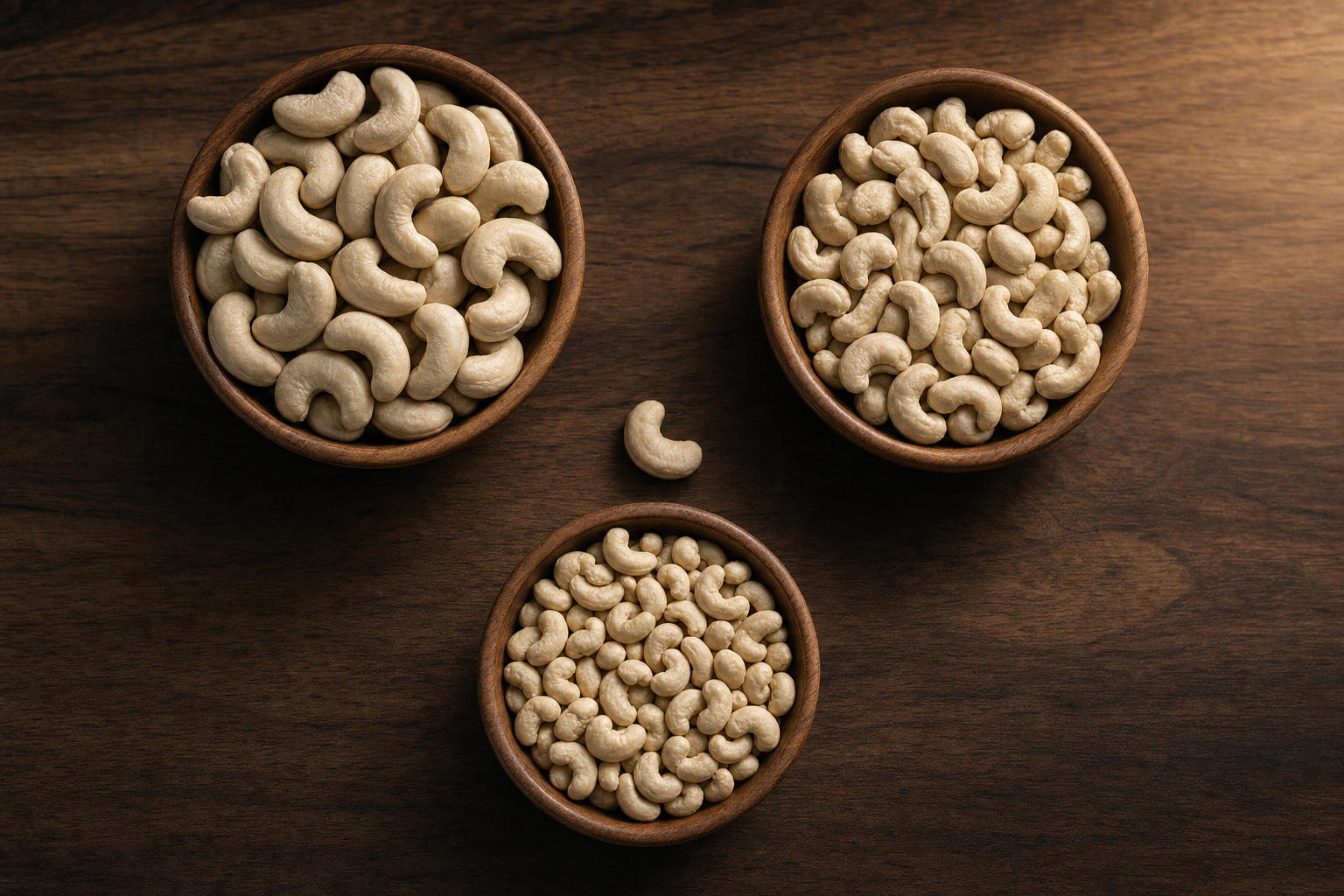
Ask any Indian shopper what the "best" cashew is and half will say W180 because that’s what’s in the gift box, and half will say W320 because that’s what’s at home. Both are wrong in different ways. The W-number is not a quality grade, it’s a count. Once you understand that, the whole cashew shelf makes sense.
The W stands for Whole. The number is a count.
The Cashew Export Promotion Council of India (CEPCI) grades whole cashew kernels by how many kernels fit into one pound (~454 g). That’s it. That’s the entire system.
- W180, around 170–180 kernels per pound. The largest whole cashew you can buy. Often called "king" or "jumbo" grade.
- W210, about 200–210 per pound. Still very large.
- W240, about 220–240 per pound. The classic mid-large size.
- W320, about 300–320 per pound. The most-shipped grade globally and the standard "eating" cashew.
- W400, about 350–400 per pound. Smaller, still whole.
- W450 / W500, small whole. Usually goes to processors.
All of these are 100% whole, 100% clean, 100% cashew. A W320 is not "worse" than a W180. It is smaller. That is the only difference the grade code communicates.
Where the grade comes from
Cashew kernels come out of the shell in a range of sizes because the fruit itself grows in a range of sizes. After the shells are cracked and the kernels peeled, workers on a sorting table separate them into these size classes using calibrated sieves and, for the top grades, hand-picking. Once sorted, each grade is graded again for colour and defects.
So a real spec sheet on a cashew lot will look like this: W320, first grade white, less than 5% broken. The size code (W320), the colour class (first white / scorched white / dessert), and the tolerance for chips and broken pieces are three separate axes. When you see "premium W320" on a packet without those other details, you are being sold on one axis and told nothing about the other two.
Colour classes: the axis nobody talks about
The whole-cashew colour classes, from top to bottom:
- W (White): uniform ivory, no dark specks. This is the export standard.
- SW (Scorched White): lightly toasted look, faint tan patches. Same nut, slightly over-roasted during the shell-removal step. Same taste, slightly cheaper.
- DW (Dessert White): uneven colour, some brown patches, still whole. Fine for cooking, barfi, kaju curry, upma, where the cashew will be blended or browned anyway.
Below whole, you have splits (W-2, S), butts (B), and pieces (LWP, SWP, BB). These are perfectly good cashews for cooking, they just aren’t whole. A gift box needs W180 first grade white. A pot of kaju curry is happy with LWP dessert.
Which grade for what
The mistake is buying up. Most Indian home cooks buy W180 or W240 for everything because they equate size with quality, then complain that cashews are expensive. Match the grade to the job:
- Gifting, garnish, table snacking: W180 or W210. You are paying for size and visual impact.
- Daily eating out of a jar, breakfast bowls, trail mix: W240 or W320. The size-to-flavour ratio is best here, you get plenty of nut per bite without paying king-grade prices.
- Barfi, kaju katli, cashew paste for curries: W320 or W400 whole, or splits. You’re going to grind them anyway.
- Cashew butter, cashew cream, plant-based cheese: Pieces (LWP or SWP) if you can get them. Same nut, 30–40% cheaper.
- Pulao, upma, poha topping: W320 splits toasted in ghee. The gold standard.
Origin matters more than grade
India, Vietnam, Ivory Coast and Tanzania are the four big cashew origins. India processes cashews from all four. A W320 from a Vietnamese processor and a W320 from a Kerala processor are the same size: but the growing conditions, the shell-cracking method (steam vs oil-bath), and the humidity control during storage all show up in the final nut.
Indian-processed cashew, particularly from Kollam and Mangalore clusters, tends to have a cleaner, sweeter finish. Vietnamese-processed cashew tends to be lighter in colour and more uniform. Neither is better. But if a packet says "Indian cashew" and the price is significantly below market, ask where it was actually processed.
How to spot a bad packet
Three quick checks before you buy:
- Rattle the packet. A good lot rattles cleanly. If you hear a dull thud, the kernels have absorbed moisture and lost their snap, a sign of poor packing or long storage before it reached you.
- Look for uniform size. A W320 packet should look like W320s. If you see obvious W180s and obvious W400s mixed in, the lot is mis-graded.
- Smell. Cashew has almost no smell when fresh. A sharp or oily note is the first sign that a pack has been sitting too long before it reached you.
Storage, the part most people get wrong
Cashew is a high-fat, low-water nut. In an Indian kitchen at 32°C ambient, an open packet of cashews starts to oxidise within two weeks. Airtight jar in the fridge extends this to 3 months easily. Airtight jar in the freezer takes it to 6+ months without any texture loss. Roast them lightly in a dry pan straight from the freezer, they crisp up in 30 seconds.
What Aplus Foods carries, and why
Under the Nuts About You brand we stock W320 whole first-grade white as our everyday cashew, and W240 first-grade white as our gifting and premium grade. We deliberately do not push W180 as a daily-use SKU because, for the way most families actually eat cashews, the price premium doesn’t buy you anything you can taste.
All lots ship FSSC 22000, US FDA registered, HACCP audited, packed at moisture below 4% in nitrogen-flushed pouches. Shelf life 9 months from pack date, and the pack date is on the pouch, not just the expiry.
The short version
W180 for gifting. W240 for treating yourself. W320 for daily. Splits and pieces for cooking. Ignore the grade-as-quality myth, look at colour class and broken tolerance, and always buy from a processor that tells you the pack date. That’s the whole game.
Related reading
- A Sourcing Guide to Indian Dry Fruit: the parent pillar to this post: origins, seasons, and honest grades across almonds, cashew, pistachios and walnuts.
- California vs Mamra Almonds, Which Should You Buy?
- Nuts About You, the full range at store.aplus.food
Premium pulses, dry fruits and more
Unpolished pulses, honestly graded dry fruits, and single-source spices, milled and packed in Nawanshahr, Punjab. FSSC 22000, US FDA and HACCP certified.
Browse the Shop →