Cashews from Panruti, Almonds from Kashmir: Reading Indian Dry Fruit
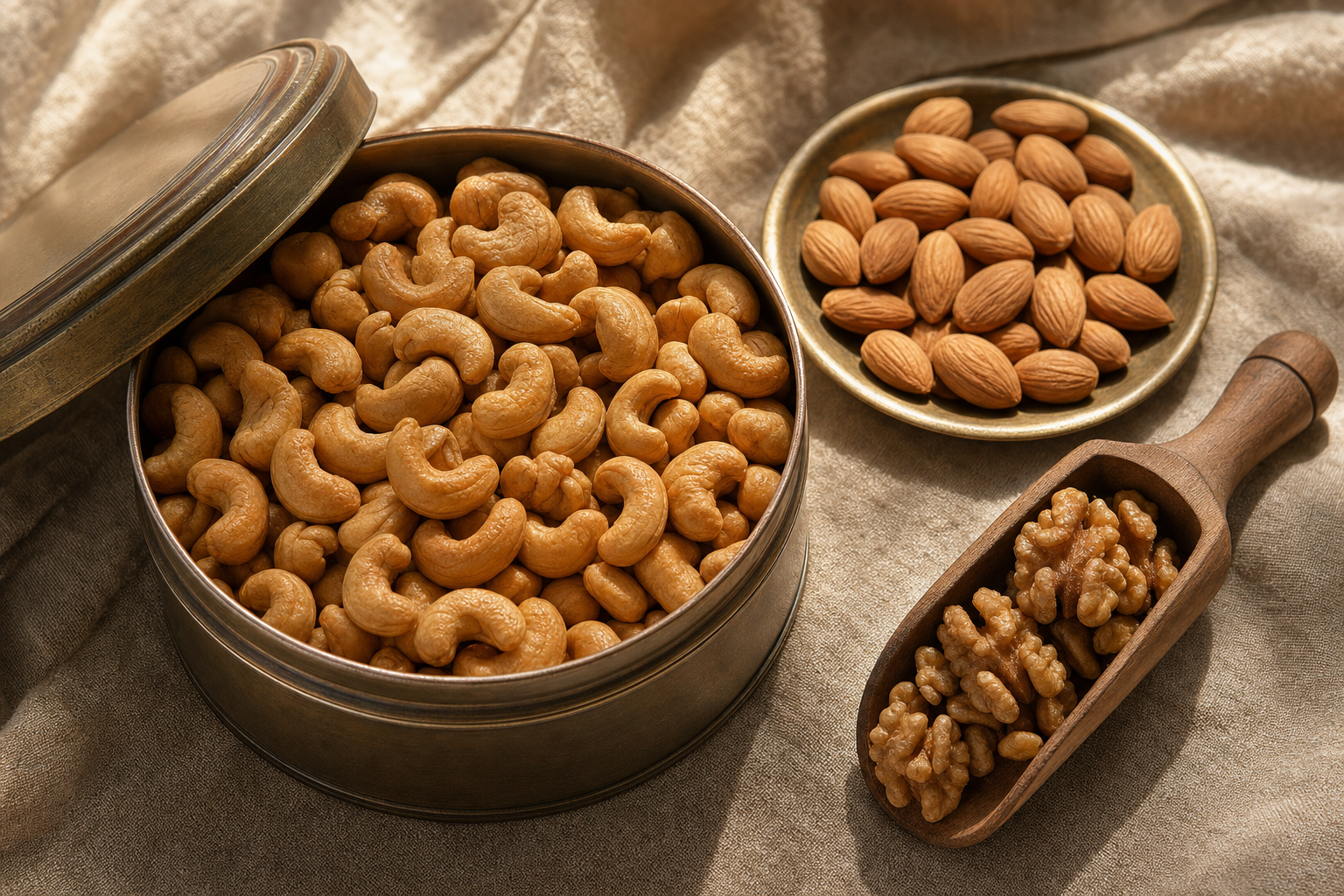
Open a tin of well-roasted cashews, the kind that has been sealed since the day it left the roaster, and the first thing you notice is not the crunch. It is the smell. A faint toastiness, something close to warm milk and butter, rising before the lid is even fully off. Compare that with a fistful of cashews scooped from an open bulk bin at a supermarket, sitting under fluorescent light for three weeks: flat, a little musty, sometimes faintly like cardboard. Same nut, on paper. Utterly different experience in the mouth.
This is not snobbery. It is chemistry. Nuts are full of unsaturated fats, and fats oxidise the moment they meet air, light and warmth. A cashew roasted last week and sealed tastes different from one roasted three months ago and left loose. Origin compounds this further: the soil, the specific cultivar, the way the kernel was dried and roasted all leave a fingerprint on flavour that survives all the way to your palate.
This is also why dry fruit resists the treatment we give, say, wheat flour. Flour is a commodity, one bag behaves much like another once milled. A cashew is not. A Panruti cashew, a Vietnamese-processed cashew and an African raw cashew roasted in Kerala can all wear the same "W240" sticker and taste like three different foods. Understanding why is the difference between buying a snack and buying a nut worth buying again. This guide is about reading the label, grade, origin, roast, instead of trusting the picture on the front of the pack.
A commodity is priced by weight. A dry fruit, done properly, is priced by story: where it grew, how it was dried, how long ago it was roasted. The label rarely tells you all three, but it usually tells you enough if you know what to look for.
The grading systems no one explains
Most dry fruit packaging carries a code, W240, Nonpareil, "light halves", that looks technical and is treated by most shoppers as decorative. It isn’t. These codes are trade standards, and they map fairly directly onto price and eating quality.
Cashews: W, the colour prefix, and the number
Cashew kernels are graded on three things: colour, shape (whole or broken) and size. The "W" that appears on most premium packaging stands for "white whole": an intact kernel, ivory to pale ash in colour, with no more than a small fraction of the kernel broken off. A "scorched whole" kernel (SW) has gone slightly further in the drying or oil-dressing process and carries a light brownish tinge, still whole, just visually less pristine.
The number that follows is simply a count: how many whole kernels make up one pound (454g) of nuts. This is the part most shoppers never have explained to them, and it matters more than the letter. A lower number means fewer, larger kernels per pound, and a higher price. A higher number means more, smaller kernels, and a lower price. Neither is a defect. They are simply different sizes of the same nut, sorted mechanically by sieve.
- W180, roughly 180 kernels per pound. The largest commonly traded grade, sometimes called the "king of cashews." Used for gifting and gourmet retail, priced 40–60% above W320.
- W210/W240, 200–240 kernels per pound. The "jumbo" and "premium large" grades most serious retail brands build their hero packs around, visually striking, without W180 scarcity pricing.
- W320, 300–320 kernels per pound. The global benchmark grade. Most bulk trade, snack mixes and "everyday" retail packs use W320; it is the crude-oil price against which every other grade is quoted.
- W450, 400–450 kernels per pound. Smaller, more affordable, used heavily in confectionery, cashew butter and cooking rather than straight snacking.
- LWP (large white pieces): not whole kernels at all, but broken pieces above a certain size, sold at a discount to whole grades and entirely fine for cooking, though a poor choice if you are paying premium-snacking prices.
None of this tells you where the nut grew or how fresh it is, only its size and cosmetic condition. A W240 cashew roasted six months ago is still a worse eating experience than a fresh W320.
Almonds: Nonpareil, Carmel, Butte. And the outliers
Almond grading works differently, because almonds sold in India are overwhelmingly Californian, and California grades by cultivar rather than a numeric size code.
Nonpareil is the industry’s flagship: thin-shelled, smooth, flat, light-skinned, and the easiest to blanch and slice, which is why it dominates confectionery and premium retail packs. Carmel is similar in flavour but slightly more elongated and thicker-skinned, often used interchangeably with Nonpareil in mixed retail. Butte is smaller and more rounded, common in roasted and flavoured lines because its shape holds coatings well. These are all cultivar names, not quality tiers, a Carmel almond isn’t an inferior Nonpareil, just a different variety bred for a different job.
Outside California, India also sees genuinely different almonds, Mamra and Gurbandi, which are covered in the next section, because they are less a grading distinction and more a different category of almond altogether.
Walnuts: light halves, amber halves, and pieces
Walnut grading is built around colour and intactness rather than size. "Light halves" are the visually palest, most intact kernels, the top grade, prized for snacking and gifting. "Amber halves" carry more of the kernel’s natural tannin colour; the flavour is marginally more robust, and the price sits a notch below light halves. Below halves come quarters and pieces, priced lower again and generally destined for baking rather than the fruit bowl. Colour in walnuts, unlike in cashews, is mostly a function of the pellicle (skin) and drying conditions rather than a sign of processing quality, an amber walnut is not a "spoiled" light one, simply a more richly pigmented kernel.
Once you can read a grade code, you can start asking the more interesting question: not just how big is this nut, but where did it come from.
Cashews: the origin map
Ask any cashew trader in India where the best kernels come from and the answer is usually the same: Panruti, in Cuddalore district, Tamil Nadu. Panruti is often called India’s cashew capital, and the description holds up: the region’s plantations and processing units anchor a large share of the country’s cashew economy, and the town’s name is shorthand in the trade for consistent, well-processed kernels. Neighbouring Cuddalore, Goa and Kerala (particularly Kollam, historically the hub of India’s cashew processing industry) round out the domestic cashew belt, each with its own micro-reputation for kernel size, colour or oil content built up over decades of processing experience.
Here is the detail most packaging omits: a large share of the raw cashew nuts processed in India are not grown in India at all. India imports substantial volumes of raw cashew from Vietnam and West African countries, Côte d’Ivoire, Benin, Tanzania, Ghana, because domestic cultivation cannot keep pace with domestic processing capacity or export demand. Those raw nuts are then shelled, dried, graded and roasted in Indian factories, including many in and around Panruti and Kollam.
This is not dishonest, but it is a genuine labelling grey area. A pack that says "Product of India" is usually correct in the strict legal sense: the processing, which adds most of the value and determines most of the eating quality, happened in India. But it says nothing about where the raw nut was grown, and a shopper reading "Indian cashew" as "grown in Indian soil" is drawing a conclusion the label never actually made. If provenance matters to you, look for brands that separate "processed in" from "grown in", the honest ones will.
The roasting method matters as much as the growing origin. Steam roasting cooks the kernel gently with moist heat, preserving more of the nut’s natural sweetness and pale colour, and is the method most associated with premium, minimally seasoned cashews. Oil roasting fries the kernel briefly in oil, producing a deeper colour, a more pronounced crunch and a richer, sometimes heavier mouthfeel, it also adds a small amount of absorbed oil to the final product. Neither method is objectively superior; they simply produce different textures, and a brand that discloses which one it uses is giving you real information, not marketing filler.
Almonds, the four Indian consumers should know
Walk into most Indian retail stores and "almonds" almost always means one thing: California, and specifically Nonpareil or Carmel. Californian orchards supply the overwhelming majority of almonds sold in Indian retail, reasonable estimates put it at roughly four-fifths of the market, because California’s industrial-scale, irrigated production delivers consistent size, colour and year-round supply at a price no traditional growing region can match. This is not a mark against California; it is a different agricultural model, optimised for uniformity and volume rather than rarity.
Three other almonds are worth knowing, because Indian buyers encounter them constantly in premium and traditional retail, often under names that get used loosely.
Mamra is the most prized of the group: grown in Iran, Afghanistan and small pockets of Kashmir, recognisable by its wrinkled, concave shape and notably high oil content (reports suggest well above the oil levels of California almonds). The higher oil content gives Mamra a softer bite and a richer, almost creamy flavour, and is also why Mamra is packed and moved quickly, and why it commands a steep premium, production is a small fraction of the global almond supply.
Gurbandi, also called Choti Giri, is grown mainly in Afghanistan. It is smaller and darker than Mamra, with a firmer bite and a deeper, more robust flavour, and a lower but still meaningful oil content. It is often confused with Mamra in Indian markets, but the two are genuinely different varieties, not just different grades of the same nut.
Kashmiri almonds are a distinct, soft-shelled, seasonal crop grown in the Kashmir valley: smaller-volume, harvested in a defined window, and prized locally for a sweeter, softer kernel. Kashmir also produces its own small quantity of Mamra-type almonds, adding to the naming confusion in retail.
India’s tradition of soaking almonds overnight before eating them has a practical origin: it softens the papery skin (which carries tannins that taste faintly bitter and can inhibit some nutrient absorption), making the kernel easier to peel and digest. The tradition applies most usefully to California almonds, which are typically pasteurised before sale, a food-safety step that can dull the skin’s texture slightly. Mamra and Gurbandi almonds, being more traditionally processed and often unpasteurised, are commonly eaten unsoaked in the regions that grow them. Soaking is a matter of texture and habit rather than a fix for a lesser product, California almonds are not an inferior almond, simply an almond bred and processed for a different purpose: consistency at scale.
Walnuts, pistachios, dates, the rest of the pantry
Kashmir has grown walnuts for centuries, and the Kashmiri walnut, thin-shelled, densely oiled, sold locally as kagzi akhrot, has a stronger, more tannic flavour and a noticeably higher natural oil content than the walnuts now flooding Indian markets from Chile and California. Imported walnuts tend to be larger, lighter in colour and milder in taste, bred and processed for visual uniformity rather than intensity of flavour; they are also typically 30–40% cheaper, which is why they have taken significant share from Kashmir’s traditional walnut trade in recent years. Neither is "better" in an absolute sense, the Kashmiri walnut rewards someone who wants a stronger, oilier bite; the imported walnut suits a milder palate and a lower price point.
Pistachios show a similar origin split. Iranian pistachios, grown at high altitude around Kerman and Rafsanjan, under intense sun and wide day-night temperature swings, develop a notably higher oil content, a deeper green kernel and a richer, more "buttery" flavour that pistachio buyers often describe as more complex than the American product. Californian pistachios, grown almost entirely from a single cultivar derived from Iranian stock, are bred and processed for uniform size, a cleaner unbleached shell and reliable food-safety controls, at the cost of some of that flavour intensity. Iranian shells are sometimes lightly bleached to even out natural discolouration, worth knowing if you see an unnaturally uniform white shell and assume it means higher quality; it may mean the opposite.
Dates show the clearest example of how much origin changes eating experience within what looks like one product category. Medjool, originally from Morocco and now grown widely in the US, Israel and Jordan, is large, soft, deeply caramel-sweet, the "king of dates" and the variety most Indian premium retailers default to. Kimia (also called Mazafati or Bam dates), from Bam in Iran’s Kerman province, is smaller, darker, extremely moist and rich, with a shorter shelf life than Medjool because of that high moisture content. Ajwa, grown almost exclusively around Medina in Saudi Arabia, is smaller, drier, prune-like and only mildly sweet, valued as much for its religious significance in Islamic tradition as for its lower sugar profile relative to Medjool.
Storage life tracks moisture content closely across all three: Ajwa’s dry, firm flesh keeps considerably longer at room temperature than Kimia’s soft, wet flesh, which is best refrigerated and used sooner. Medjool sits in between: moist enough to need cool storage for best results, but robust enough to travel and gift well, which is a large part of why it dominates retail shelves globally.
The roasting question
Raw nuts are not automatically the healthier or the more "natural" choice, they are simply an earlier stage in processing, with a different flavour and shelf-life profile than roasted nuts. Roasting drives off surface moisture, develops flavour through the Maillard reaction, and improves crunch; it does reduce some heat-sensitive nutrients marginally, but for a snacking nut this is rarely the deciding factor.
Dry roasting uses hot air or a dry pan, with no added fat: the resulting nut is lighter, slightly less rich, and closer in calorie count to the raw kernel. Oil roasting introduces a thin layer of oil during roasting, producing a glossier, richer, often crisper result, along with a modest increase in fat content from the absorbed oil. Premium retailers typically sell plain roasted and roasted-and-salted as separate SKUs rather than one default product, because salt levels and roast style are genuinely matters of preference, a household managing sodium intake needs the plain version, not a "lightly salted" compromise.
Buying raw and roasting at home is worth doing if you want to control both variables, timing and salt, and it is straightforward. Cashews and almonds do well at around 150–160°C for twelve to fifteen minutes, stirred once or twice for even colour; walnuts and pistachios, being oilier, scorch faster and are better at a slightly lower 140–150°C for eight to ten minutes. The nut is done when it smells toasted rather than raw and takes on a shade of colour deeper than its raw state, a minute past that point and the same fats that make nuts taste good will start to taste bitter and take on a faintly burnt-oil edge that doesn’t reverse.
Adulteration and mislabelling
Dry fruit is unusually easy to adulterate because much of the quality judgement happens by eye and by weight, both of which can be manipulated. Cashew shell fragments, small, hard, dark pieces of the outer shell not fully removed during processing, are a genuine hygiene and safety issue in poorly controlled mills; they are sharp, indigestible, and occasionally contain traces of the shell’s caustic oil, which can irritate the mouth. Careful shelling and multiple sorting passes (mechanical and manual) are what prevent this, and a facility running to FSSC 22000 standards has documented controls specifically for foreign-body contamination of exactly this kind.
Raisins are commonly treated with sulphur dioxide (SO2) during drying, a legal and widely used preservative that also happens to keep raisins looking bright gold rather than naturally darkening to brown. The practice is not inherently dangerous within regulated limits, but it is routinely under-disclosed, and a raisin that looks unnaturally golden and glossy rather than matte and varied in colour has very likely been treated more heavily than a naturally sun-dried batch. Sensitive individuals can react to sulphites, which is why proper labelling of SO2 content matters more than the marketing copy around it.
Dates carry their own version of the problem: lower-grade or slightly stale dates are sometimes given a sugar syrup coating to restore gloss and sweetness, then sold at prices implying premium Medjool quality. A genuine, fresh Medjool needs no added sugar: its natural sugars migrate to the surface as a light, dry, matte dusting (sometimes called "sugar flagging"), which looks different from a wet, sticky, syrup-glazed surface. If a pack of "premium" dates leaves a sticky residue rather than a light dusting on your fingers, that is worth noticing.
Certifications such as FSSC 22000, US FDA registration and HACCP exist precisely to police this chain: mandating hygienic mill conditions, documented pest and foreign-body control, verified supplier sourcing and batch traceability. None of these guarantee flavour, but they meaningfully reduce the odds of contamination, mislabelling and undisclosed additives reaching the consumer.
How to check freshness at home
The most reliable freshness test for any nut is your nose, not your eyes. Fresh nuts smell mild, faintly sweet or toasted if roasted; rancid nuts smell sharp, waxy, or faintly like old paint or crayons: a smell that, once noticed, is hard to un-notice. If a pack smells "off" in this way, the fat has oxidised and no amount of freshness elsewhere in the batch will fix it.
The bite test is the second check. A fresh nut should snap cleanly and cleanly, crisp, not leathery or chewy. A cashew or almond that bends or feels soft before it breaks has likely absorbed moisture or aged past its best. Dates work in reverse: they should be soft and pliable but not wet or sticky to the point of leaving syrup on your fingers, that stickiness usually signals either an overly moist variety past its ideal window, or an added sugar coating.
A final visual check applies mainly to nuts sold in bulk or in clear packaging: a faint white or pale bloom on the surface of cashews or almonds can indicate oil migrating to the surface as the nut ages, not dangerous, but a sign the pack has been sitting for a while and should be used soon or checked closely for smell.
Storage: how long each keeps
Cashews and walnuts are the most oil-rich, and therefore the most vulnerable to rancidity at room temperature, particularly in Indian summers. Refrigerated, they hold reasonably well for a few months; frozen in an airtight container, both can comfortably extend well past twelve months without meaningful flavour loss, since freezing halts the oxidation process almost entirely. Almonds and pistachios are slightly more stable at room temperature thanks to their skins and shells, but still benefit from refrigeration if you are buying in bulk.
Dates behave differently, since their concern is moisture rather than oil. Ajwa and other drier dates keep well for around six months at room temperature in a sealed container; moister varieties such as Kimia are best refrigerated and used sooner. Raisins, once a pack is opened, are best used within about three months: after that, both texture and flavour start to decline, even though visible spoilage may not be obvious.
Frequently asked questions
How many soaked almonds should I eat daily?
Most nutrition guidance suggests around 8–10 almonds a day for a typical adult as part of a balanced diet, enough to gain the fibre, vitamin E and healthy fats without a significant calorie load. Soaking overnight is a matter of digestibility and texture preference rather than a strict nutritional requirement.
Are cashews too calorie-dense for daily snacking?
Cashews carry a meaningful calorie load, roughly 550 calories per 100g, so portion matters more than avoidance. A small daily handful (around 15–20g) fits comfortably into most diets; treating an open tin as a bottomless snack is where the calorie count adds up quickly.
Do raisins count as added sugar?
No: raisins contain naturally occurring fruit sugars, not added sugar, though the sugar is concentrated by the drying process, so portion size still matters for anyone managing blood sugar or calorie intake.
Can diabetics eat dates?
In moderation, yes, though variety matters. Lower-glycaemic options such as Ajwa are gentler on blood sugar than very sweet varieties such as Medjool. Anyone managing diabetes should treat dates as a controlled-portion food and check with a healthcare provider on quantity.
Can nuts be stored in the freezer without losing quality?
Yes: freezing is one of the most effective ways to preserve oil-rich nuts like cashews and walnuts, slowing oxidation dramatically and extending usable shelf life well beyond twelve months in an airtight container, with minimal impact on flavour once thawed.
Reading a dry fruit label properly, grade, origin, roast method, and a few freshness cues, turns a routine purchase into an informed one. For a deeper look at almond varieties specifically, see our almond variety guide. To shop graded, origin-labelled nuts directly, visit the Nuts About You store, and browse more origin-first writing on the Aplus Foods blog. For the full range of graded cashews, almonds, walnuts, pistachios, raisins and dates, the Nuts About You collection lists origin and grade on every pack.
See our full premium dry fruits range on the Aplus Foods store.
Premium pulses, dry fruits and more
Shop heritage Aplus Foods products. Free shipping above ₹999. FSSC 22000 · US FDA · HACCP certified.
Browse the Shop →