Pure Jaggery Without Sulphur: The Definitive Guide to Indian Gur
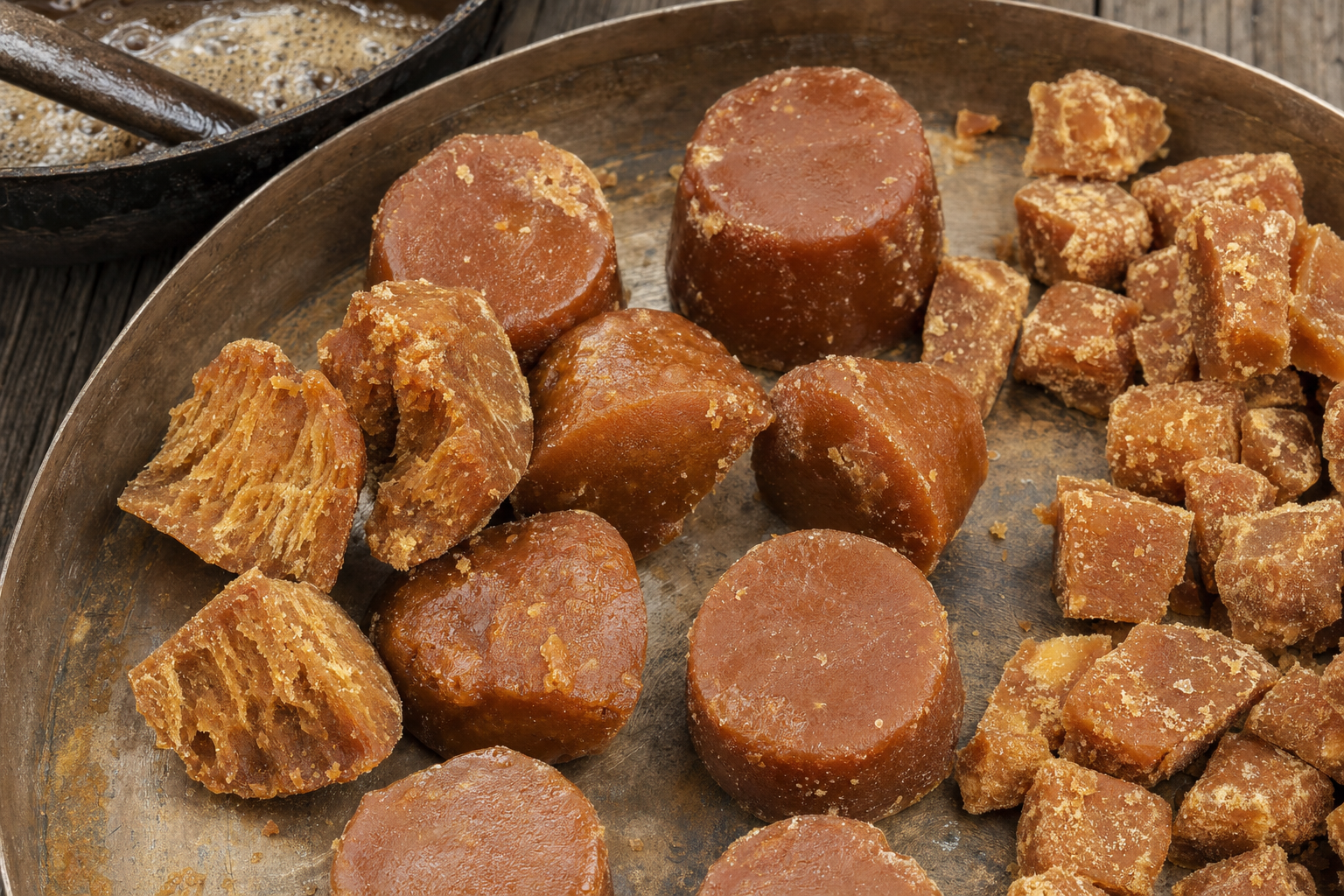
There is a moment in every jaggery kitchen, every gurhal, every roadside bhatti, when the boiling cane juice stops behaving like a liquid and starts behaving like a memory. It thickens, it darkens, it throws off a smell that is part caramel, part burnt sugar, part something that has no name in English. Someone dips a ladle, lets it fall, and watches whether it forms a thread. When it does, the pan is lifted off the fire and poured into a shallow tray to cool.
That is the moment we are interested in at Aplus Foods. Not the nutrition panel, not the marketing claim. The tray. Because what happens in the minutes after pouring, and in the months before it, determines almost everything about the jaggery you eventually put in your tea.
A nutrition label can tell you the iron content of jaggery. It cannot tell you whether the cane was pressed within hours of cutting, whether the juice was clarified with lime and lemon or with sodium hydrosulphite, or whether the block cooling in front of you is amber because it is honest, or pale because it has been bleached. This guide is about the parts of jaggery that labels leave out, and why, at Aplus Foods, we think they matter more than anything printed on a pack.
What is jaggery, exactly?
Jaggery, gur in Hindi, gul in Marathi, vellam in Tamil, is non-centrifugal cane sugar: sugarcane juice (or palm or coconut sap) that has been boiled down and solidified without ever being spun in a centrifuge to separate the crystals from the molasses. That single missing step is the entire story of jaggery.
White sugar is made by crystallising sucrose out of cane juice and then spinning that crystal mass in a centrifuge, which flings away the molasses, along with most of the minerals, colour and flavour compounds that were in the original juice. What is left is chemically pure sucrose: refined, decolourised, and largely inert nutritionally. Jaggery skips that separation entirely. The juice is boiled, clarified of visible impurities, and reduced until it sets. The molasses stays in. So do the minerals, the trace organic acids, and the colour.
This is also why jaggery is not one product but a family of them. Dhela or block jaggery is poured into large moulds and sets as a solid, often sold in irregular lumps. Cube jaggery is the same process poured into smaller, uniform moulds, easier to portion, and increasingly the format of choice for households that want consistency. Powder, sometimes called shakkar or khandsari in its coarser forms, is jaggery that has been granulated after setting, making it easier to measure and dissolve. And liquid jaggery, less common outside cane-growing belts, is the syrup stage caught before it solidifies, used in some regional sweets and preparations.
None of these forms is inherently better than another, the right one depends on what you are cooking. But all of them, if made honestly, should carry the same signature: a colour and aroma that comes from real cane, not from a chemical bath.
Sugarcane, palm and coconut jaggery: three sources, three profiles
Most people encounter jaggery as one undifferentiated brown block. In truth, jaggery in India comes from three principal sources, each rooted in a different agricultural geography and each tasting distinctly different.
Sugarcane jaggery is by far the largest category, produced wherever cane is grown at scale: Maharashtra, Uttar Pradesh, Karnataka, parts of Tamil Nadu and Andhra Pradesh. Maharashtra alone accounts for a substantial share of national output, with Kolhapur as its most celebrated centre. Sugarcane jaggery has a rounded, molasses-forward sweetness: deep, slightly smoky at its best, with a lingering caramel note. It is the jaggery most Indian households mean when they say "gur" without qualification.
Palm jaggery comes from the sap of the palmyra or date palm, tapped much like rubber, and is concentrated in Tamil Nadu, parts of Odisha, and pockets of Andhra Pradesh. It sets softer and grainier than cane jaggery, with a flavour that is less sweet and more mineral, almost smoky-bitter at the edges. In Tamil Nadu, palm jaggery, panangkarupatti, is often considered superior to cane jaggery altogether, and is priced accordingly.
Coconut jaggery is a coastal speciality, most associated with Kerala, made from the sap of the coconut palm’s flower spathe. It is darker still, with a distinctive treacle-like richness and a lower, more restrained sweetness than either cane or palm jaggery. It is prized in Kerala’s own sweets and is increasingly sought after for its lower glycaemic load relative to cane jaggery, though it is not a "free" sugar by any means.
Which to use is largely a matter of what you are making and where your palate has been trained. Cane jaggery is the reliable all-rounder: chai, laddoos, chikki, gur-rice. Palm jaggery suits South Indian sweets like ellu urundai and payasam where its stronger, more savoury sweetness is expected. Coconut jaggery works beautifully in payasam and in coffee, where its treacle notes complement rather than compete. None of the three should taste flat or one-dimensional, if it does, the problem is usually not the source but the processing.
The sulphur problem, the differentiator
This is the section that matters most, and the one the jaggery trade would rather you not read closely.
Walk into most Indian grocery stores and the jaggery on the shelf is often a uniform, pale golden yellow, almost the colour of light brown sugar. This is not what unadulterated jaggery looks like. Cane juice, boiled down honestly, produces a jaggery that ranges from amber to a deep, almost chocolate brown, depending on the cane variety, the soil and the boiling method. Pale yellow jaggery is, in the overwhelming majority of cases, evidence of chemical treatment.
The most common agent is sodium hydrosulphite (also called sodium dithionite or, colloquially in mills, "hydrose"), a reducing and bleaching compound more commonly used in the textile and dyeing industry. Added during boiling, it strips colour from the cane juice much as it strips dye from cloth, producing the bright, uniform gold that many buyers have mistakenly come to associate with "clean" or "premium" jaggery. A related practice uses super-phosphate or ortho-phosphoric acid as a clarifying and settling agent, which helps impurities rise and separate faster, again yielding a paler, more translucent product with a longer apparent shelf life.
The health implications are not hypothetical. Investigations into jaggery markets in Karnataka’s Mandya belt, one of India’s largest jaggery trading hubs, found measurably higher residual sulphur dioxide in the palest jaggery samples compared with darker, traditionally processed ones, precisely the units that had used sodium hydrosulphite and similar sulphur-based whitening agents most heavily, according to reporting in The Hindu. Sulphite residues are a recognised concern for individuals with asthma and sulphite sensitivity, and their presence defeats the entire premise of jaggery as a "natural" sweetener. There is also a practical downside: sodium-based bleaching agents are hygroscopic, meaning they pull in atmospheric moisture, which is why heavily treated jaggery tends to turn soft and mushy far sooner than it should.
Dark jaggery is not a defect to be corrected. It is the correct outcome of an honest process: cane juice, lime, heat, and nothing else.
Ironically, the market has trained a generation of buyers to associate pale colour with purity and dark colour with impurity, the exact inverse of the truth. As Wikipedia’s entry on jaggery notes, the deep brown colour of unclarified jaggery reflects the full retention of natural nutrients, and buyers who reject it in favour of golden-yellow jaggery are, in effect, selecting a product closer to refined sugar dressed up as gur.
This is the single biggest reason to buy jaggery from a source that tells you where it comes from, rather than from an anonymous sack in a wholesale market. Premium jaggery should look like what it is: cane juice, reduced by heat, nothing more.
Kolhapur: the champagne region of jaggery
If any single place in India has earned the right to be called the reference point for sugarcane jaggery, it is Kolhapur, in western Maharashtra. The comparison to Champagne is not idle marketing language: like the French region, Kolhapur’s reputation rests on a specific combination of cane variety, water, soil and inherited craft that has proven difficult to replicate elsewhere at the same quality.
The cane grown along the Panchganga river belt, including the Kagal and Warana talukas, benefits from fertile black soil and a reliable irrigation network that produces juice with a particular sugar-to-mineral balance. Local producers have refined the boiling process over generations into something close to a craft discipline, traditionally divided among specialist roles: the chulvan, who manages the furnace and heat distribution; the adsule, who clarifies the molasses; and the gulave, the most senior figure, who judges by instinct and experience exactly when the boiling syrup is ready to be poured, without thermometers or refractometers.
This traditional method is known as the open-pan or bhatti process: cane juice boiled in large, shallow, round-bottomed pans over a wood or bagasse fire, clarified with small quantities of lime rather than chemical bleaches, and reduced by eye and feel rather than by instrument. It is slower and less predictable than industrial processing, but it produces jaggery with genuine depth of colour and flavour.
The reputation of the region is now formally recognised: Kolhapur jaggery received Geographical Indication (GI) status from the Geographical Indications Registry, making "Kolhapur jaggery" a protected regional name in the same way Darjeeling tea or Champagne itself is protected, a legal acknowledgement that geography and method here are inseparable from the product’s identity.
It is this belt that Aplus Foods sources its sugarcane jaggery from. Not because the label reads well, but because after decades of working with cane and grain across Punjab and beyond, this is where the balance of juice quality and traditional processing consistently produces jaggery with the colour, aroma and mineral depth that chemically treated jaggery cannot fake.
Reading the jaggery you buy
You do not need a lab to judge jaggery. Your eyes, nose and fingers are enough, if you know what to check.
Colour. Look for amber, deep gold, or brown: the colour of tea, treacle or old wood, not the colour of pale butter. A perfectly uniform, bright pale-yellow block, especially one that looks the same from batch to batch, is the strongest single warning sign of chemical clarification.
Texture. Good jaggery powder should be granular and free-flowing, not caked into a solid, damp lump. Good cube or block jaggery should have a slightly matte, faintly crystalline surface: not a glassy, waxy sheen, which often indicates additives used to hold shape and gloss.
Taste. This is the most reliable test of all. Honest jaggery has a rounded, clean sweetness that finishes with a caramel or molasses note. Chemically treated jaggery often tastes flatter up front and leaves a faint metallic or chemical aftertaste at the back of the tongue, subtle, but noticeable once you know to look for it.
Moisture. Jaggery should feel dry to slightly tacky, never wet or visibly "sweating." A block that has beads of moisture on its surface at room temperature, outside of peak summer humidity, has likely been treated with hygroscopic bleaching agents that pull water from the air.
Aroma. Bring a piece close to your nose. It should smell like caramelised sugar and molasses: warm, slightly smoky in cane jaggery, faintly nutty in palm jaggery. A block with little to no smell, or a faint sulphurous or chemical note, has almost certainly been processed with additives rather than reduced purely by heat.
None of these checks require special equipment, and together they are more informative than any claim printed on packaging. If you are buying jaggery for the first time from a new source, buy a small quantity and run through all five checks before committing to a larger order, a practice worth applying to the range of jaggery formats available at Aplus Foods as much as to any other producer.
Nutrition and Ayurveda
Jaggery is not a health food in the sense that word is often used online, and it should not be marketed as one. It is, however, meaningfully different from refined sugar in composition. Because the molasses is retained rather than spun away, jaggery carries measurable amounts of iron, potassium and magnesium that white sugar simply does not contain: figures commonly cited put iron at around 10–11 mg and potassium above 1,000 mg per 100 g, according to compiled nutritional data referenced on Wikipedia’s jaggery entry. These are not trivial quantities in a country where iron-deficiency anaemia remains widespread.
The important caveat: jaggery is still overwhelmingly sucrose. Its glycaemic index sits above 60, placing it firmly in the "high GI" category, not meaningfully gentler on blood sugar than table sugar, gram for gram. Anyone managing diabetes or insulin resistance should treat jaggery as sugar with better trace nutrition, not as a diabetic-safe substitute.
Within Ayurveda, jaggery occupies a specific and long-standing place. It is considered warming, and is traditionally favoured in winter months to counter cold, damp constitutions. A small piece after a meal is a common digestive custom, believed to aid the final stages of digestion and prevent the heaviness that follows a rich meal. The pairing of jaggery with ghee, a small lump of gur alongside a spoon of ghee, particularly in the colder months, is one of the more enduring combinations in Indian home remedies, valued for its combination of warming and lubricating qualities. None of this substitutes for medical advice, but it explains why jaggery has never been treated in Indian households as merely a sugar substitute, it has always carried its own separate identity.
How to use jaggery at home
Jaggery does not behave identically to sugar, and substitution is not always a straight swap.
As a general rule, you can replace sugar with jaggery at a ratio of roughly 3:4 by weight: that is, for every 100 g of sugar a recipe calls for, use about 130–140 g of jaggery, since jaggery carries less pure sucrose per gram and slightly more moisture. This works well in tea, coffee, warm milk, and dishes where a slight colour change is welcome or invisible: dals, gravies, chutneys, marinades.
It works less well in recipes that depend on sugar’s precise crystallisation behaviour: delicate meringues, certain cakes, and confections where colour and clarity matter, since jaggery will darken the final product and introduce its own flavour. In these cases, use jaggery only where the recipe is designed around it.
Some classic applications reward jaggery specifically, rather than merely tolerating it as a substitute:
Tea and coffee. A small piece of jaggery dissolved into hot chai adds a rounder sweetness than sugar and pairs particularly well with ginger and cardamom.
Chikki. Peanut or sesame chikki depends on jaggery’s specific setting behaviour when melted and combined with nuts, sugar produces a harder, glassier bite that lacks the same depth.
Laddoos. Til (sesame) and peanut laddoos traditionally use jaggery, both for flavour and because its slight stickiness helps bind the mixture without additional syrup.
Gur ke chawal. A Punjabi favourite: rice cooked with jaggery, ghee and dry fruits, often prepared for festive occasions such as Lohri, where jaggery’s caramel notes are the entire point of the dish.
Bengali payesh. Date-palm jaggery, or nolen gur, is central to the winter version of this rice pudding, prized specifically for the smoky, almost wine-like sweetness that only that particular jaggery source provides.
Warm gur-milk. A simple glass of warm milk with a small piece of jaggery dissolved in, often taken before bed in winter, is one of the oldest and simplest applications, closer to a household ritual than a recipe.
For everyday cooking, jaggery powder tends to be more convenient than block or cube, since it dissolves faster and measures more predictably. For festive sweets and chikki, block or cube jaggery, broken or grated by hand, often gives better control over texture during melting.
Storage and shelf life
Jaggery’s greatest enemy is humidity, not time. Left in an open container in a humid kitchen, jaggery will absorb moisture from the air and soften, eventually turning sticky or, in extreme cases, developing surface mould.
Store jaggery in an airtight container, glass or food-grade plastic with a tight seal works better than the cloth or paper wrapping it is often sold in. Keep it in a cool, dry cupboard, away from direct sunlight and away from the stove, where ambient heat and steam accelerate softening.
Some seasonal softening, particularly during the monsoon or in especially humid summer months, is normal and does not indicate spoilage, it is simply the jaggery responding to atmospheric moisture, a tendency that is more pronounced in untreated jaggery precisely because it has not been chemically stabilised against it. If a block has softened, refrigeration in an airtight container will usually firm it back up. Genuine spoilage, visible mould, a sour or fermented smell, is different from simple humidity softening and should not be ignored.
Properly stored, most jaggery keeps well for six to twelve months, with powder generally more stable than block due to its lower surface exposure once sealed.
Frequently asked questions
Is jaggery safe for diabetics?
Not inherently. Jaggery has a glycaemic index above 60, similar in practical terms to white sugar. It offers better trace minerals, but it is not a low-sugar or diabetic-safe sweetener and should be used sparingly, with medical guidance, by anyone managing blood sugar.
Is jaggery better than honey?
They are different products with different uses. Honey is largely fructose and glucose in liquid form with its own antimicrobial properties; jaggery is a concentrated, solid sucrose product with retained plant minerals. Neither is a "free" sugar, and the better choice depends on the application rather than a general health ranking.
What is the difference between organic and natural jaggery?
"Natural" typically refers to processing method, no chemical bleaching or clarifying agents, regardless of how the cane was farmed. "Organic" is a certified farming standard, referring to how the cane itself was grown, without synthetic pesticides or fertilisers. A jaggery can be organic but still chemically bleached, or natural but grown conventionally. Ideally, look for both.
Should I buy jaggery powder or cubes?
Powder is more convenient for everyday cooking, tea and coffee, since it dissolves quickly and measures consistently. Cubes or blocks are better suited to sweets like chikki and laddoos, where you often need to melt or grate the jaggery and want more control over quantity and texture.
Why is cheap jaggery often so pale?
Pale, uniformly golden jaggery is frequently a sign of chemical clarification using agents such as sodium hydrosulphite or phosphoric acid, used to bleach colour and speed up processing. Genuine, unbleached jaggery made from properly boiled cane juice is naturally amber to dark brown. Explore the jaggery range at Aplus Foods to compare colour and texture directly against what is typically sold as "premium" in the wider market.
See our full sulphur-free jaggery range on the Aplus Foods store.
Premium pulses, dry fruits and more
Shop heritage Aplus Foods products. Free shipping above ₹999. FSSC 22000 · US FDA · HACCP certified.
Browse the Shop →