Whole Spices vs Ground: The Indian Pantry Handbook
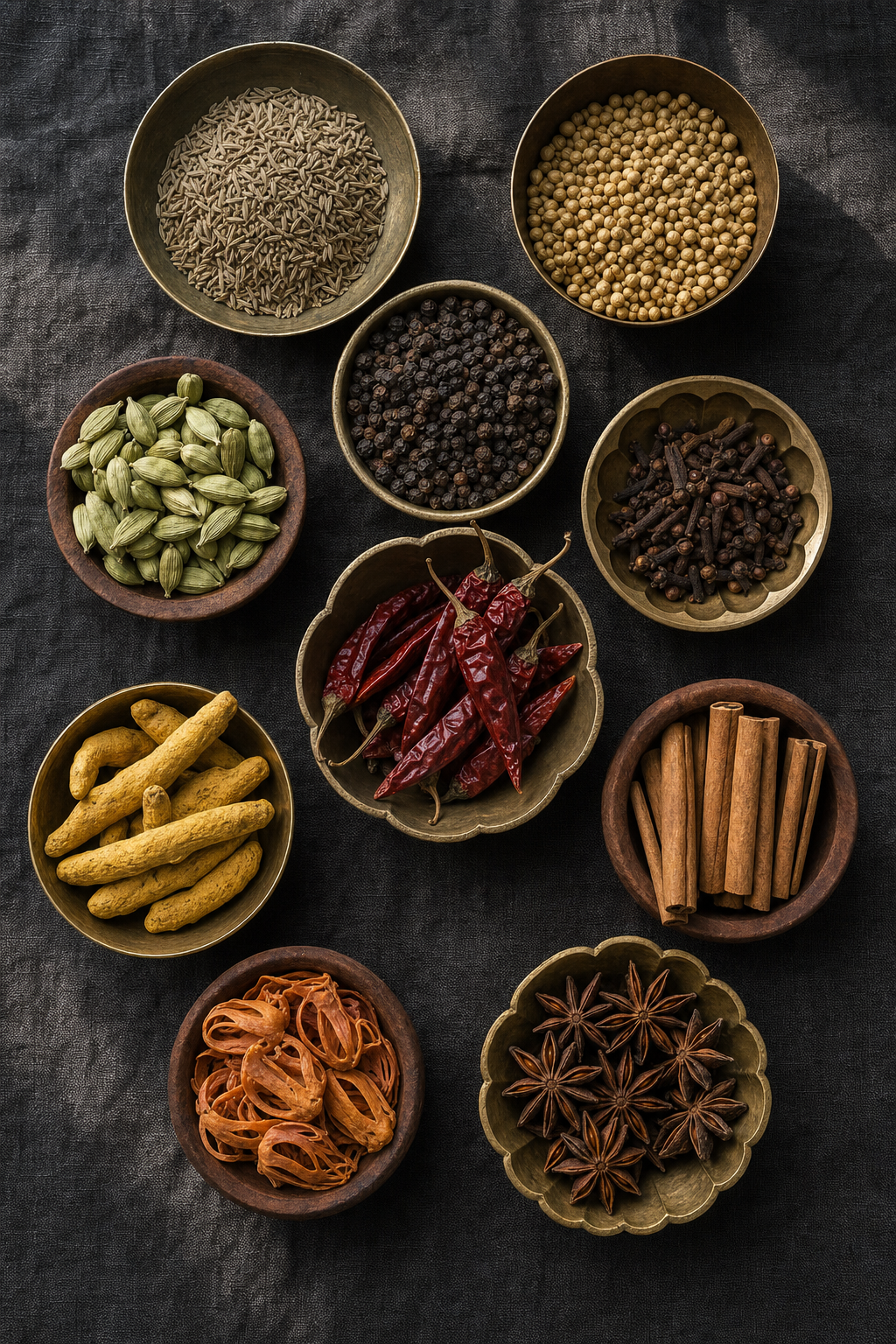
Opening the jar
Open a jar of jeera you ground this morning and the smell arrives before you have even lifted the lid properly, sharp, warm, faintly citrus, a little like toasted earth. It clears your sinuses. Now open a jar of ground jeera that has sat at the back of the shelf for six months. There is still a smell, technically. But it is thin, dusty, more memory of cumin than cumin itself. Half-close your eyes and you could mistake it for sawdust with a rumour of spice in it.
This is not a matter of taste snobbery. It is chemistry. Whole cumin seeds carry their volatile oils sealed inside a tough seed coat, released only when you crush or heat them. Ground cumin has already surrendered its oils to the air, every day on the shelf, a little more of it evaporates into nothing. A cook who grinds jeera fresh for a tadka is working with an entirely different ingredient to a cook reaching for a tin bought at the start of the year, even if the label on both says "cumin powder". The gap between the two is the entire subject of this handbook, and it explains why the whole spices vs ground spices debate is not really a debate for anyone who has smelled both side by side.
Why whole beats ground, the science
Spices taste and smell of what chemists call volatile oils, compounds like cuminaldehyde in jeera, cinnamaldehyde in cinnamon, and curcumin-adjacent oils in turmeric that carry aroma, flavour and, in several cases, much of the plant’s traditional health value. These oils are chemically restless. They oxidise on contact with air, they evaporate faster in heat, and they break down under light. A whole spice, a peppercorn, a cinnamon quill, a dried chilli, protects its oils behind a husk, a bark layer or a seed coat. Grinding breaks that seal and multiplies the surface area exposed to oxygen many times over. What was a slow, years-long process of decline becomes a matter of months.
The decline is measurable and it is not gentle. Ground turmeric loses a meaningful share of its aromatic oils and colour intensity within around six months of grinding, even stored well; independent reviews of turmeric ageing note that curcumin content can fall by up to a quarter within a year at room temperature, alongside volatile oil losses exceeding 40 per cent. Ground jeera fades faster still, three months is a realistic ceiling before the citrus-forward top notes disappear and only a flat, bitter background remains. Ground coriander sits in between, reliably good for around four months before it turns papery. Whole versions of the same three spices, kept properly, hold their character for a year or more.
This is also why nearly every serious cook, home or professional, grinds just before use wherever the recipe allows. It is not ritual for its own sake. A tempering (tadka) of whole jeera and mustard seeds cracked in hot ghee releases oils at the exact moment they are needed, rather than oils that have been sitting in a tin since last season. Restaurant kitchens that build a reputation on their masalas almost always keep a dedicated grinder running through service, because a kitchen’s food is only as good as the freshness of what goes into the pan. At home, the same logic scales down neatly: a small batch ground weekly outperforms a large tin that has sat open for a year, every time.
The 12 spices every Indian kitchen actually needs
Most Indian cooking, for all its regional range, is built from a surprisingly compact list. Twelve spices carry the vast majority of dishes across the country’s kitchens. Where a spice comes from changes what it tastes like almost as much as what it is.
Jeera (cumin): Gujarat and Rajasthan grow the bulk of India’s cumin, with warm, dry conditions concentrating its earthy, slightly bitter oils. Dhania (coriander seed): much of it comes from Madhya Pradesh and Rajasthan, prized for its citrus-sweet, slightly floral profile once roasted. Haldi (turmeric), Alleppey in Kerala produces the benchmark, high-curcumin variety used as the industry reference point; Sangli in Maharashtra supplies most of India’s commercial volume. Red chilli, Guntur in Andhra Pradesh is synonymous with heat and pungency, while Byadgi in Karnataka is grown for deep colour with comparatively gentle heat. Black pepper (kali mirch): Kerala’s Malabar coast and the Wayanad highlands are pepper’s heartland, with hill-grown lots developing more complex, citrus-tinged oils than lowland pepper. Cardamom: green cardamom from Idukki in Kerala carries the eucalyptus-sweet note essential to garam masala, while black cardamom, mostly from Sikkim and the eastern Himalayas, brings a smoky, resinous depth. Cinnamon and cassia: true Ceylon cinnamon is delicate and citrus-sweet, while the thicker, stronger cassia bark widely sold in India (often from the north-east) is what most home kitchens actually use. Cloves: Kerala’s Idukki and Kanyakumari in Tamil Nadu are the main growing belts, producing the pungent, faintly sweet spice essential to biryani and garam masala. Bay leaf (tej patta): grown across the Himalayan foothills, it is subtler in Indian cooking than the Mediterranean bay leaf, closer in flavour to cinnamon. Methi (fenugreek seed), Rajasthan is the dominant grower, and its bitterness is the backbone of pickles and many spice blends. Ajwain (carom seed), also largely from Rajasthan and Gujarat, sharply thyme-like and used sparingly. Mustard seed, grown widely across northern and eastern India, with black and brown varieties forming the base of most tadkas.
Buy any of these as whole spices where you can. A jar of whole green cardamom pods, whole cloves and cinnamon bark will outlast their ground equivalents many times over, and cost less per use, because nothing is lost to the air while it waits.
Adulteration, the honest picture
It would be dishonest to write a spice guide for the Indian market and skip this. Spice adulteration is a real, documented problem, not a scare story. Turmeric adulteration with lead chromate, an industrial yellow dye used to make pale or old turmeric look more vividly golden, has been identified repeatedly by researchers studying Indian and South Asian turmeric supply chains, precisely because lead chromate is cheap and visually convincing. It is also toxic, and there is no safe level of dietary lead exposure. Red chilli adulteration is just as well documented: brick dust or talc bulks up the powder’s weight, while Sudan red, an industrial dye banned for food use, has triggered spice recalls across multiple countries when used to fake a deeper, more expensive-looking red. Black pepper is sometimes stretched with dried papaya seeds, which look similar once ground but carry none of pepper’s pungency or oils. Ground coriander has, in the worst cases, been bulked with sawdust or other fillers that add volume without adding flavour.
None of this is inevitable, it is a function of how tightly a supply chain is controlled, and where the cost pressure in that chain sits. Reputable manufacturers stop adulteration long before packaging, at the mill. Sortex optical sorting removes foreign matter, discoloured seeds and contaminants by colour and shape before a spice is ever ground. Facilities certified to FSSC 22000, the food safety management standard we hold at Aplus Foods, are independently audited on exactly these control points: raw material traceability, contaminant testing, and batch-level accountability from the growing region through to the finished pack. It is a slower, more expensive way to make spices. It is also the only way to guarantee what is in the jar is what the label says.
There are simple checks anyone can do at home, though none are foolproof on their own. For turmeric, stir a pinch into a glass of water: pure turmeric settles with a light yellow trail, while adulterated turmeric with added dye tends to release colour rapidly and unevenly. For red chilli powder, drop a little into water. Pure chilli floats and colours the water gradually, while brick dust or added colour sinks quickly or bleeds too fast. For black pepper, a magnifying glance at whole peppercorns will show papaya seeds are smoother, flatter and lack pepper’s distinctive wrinkled surface. For ground coriander, rub a pinch between your fingers. Sawdust feels distinctly fibrous rather than the coarse, oily grain of real ground coriander. These are useful sense checks, not laboratory tests, and the more reliable long-term answer is sourcing from a mill that publishes its certifications and can trace a batch back to a growing region.
Single-origin vs blended sourcing
Not all chilli is Guntur chilli, and not all pepper is Malabar pepper, even when the packet says so. Origin changes flavour in ways that matter to a serious cook.
Guntur chilli, grown in Andhra Pradesh, is prized for high capsaicin content and a sharp, direct heat, it is the chilli of choice where a dish needs punch. Byadgi chilli, grown mainly in Karnataka, is almost the opposite brief: comparatively mild, but exceptionally high in the pigment that gives curries their deep red colour, which is why so many restaurant-style gravies lean on Byadgi rather than Guntur. Using one where a recipe calls for the other changes both the heat and the colour of the final dish, sometimes dramatically.
Pepper tells a similar story. Standard Malabar black pepper, grown across Kerala’s coastal belt, is clean and reliably pungent, the everyday workhorse. Pepper grown higher up, in the Wayanad hills, develops noticeably more complex, citrus-and-eucalyptus toned oils because the berries mature more slowly at altitude; tasted side by side, Wayanad pepper reads as brighter and more layered than lowland Malabar pepper of the same variety.
Turmeric follows the same pattern. Alleppey turmeric from Kerala is the benchmark for curcumin content in Indian turmeric, regularly testing at 5 to 7 per cent curcumin against a national average closer to 2 to 4 per cent, which is why it commands a real price premium and is the variety pharmaceutical and high-end food buyers specify by name, rather than simply asking for "turmeric".
Origin is not a marketing word for a spice. It is the difference between a chilli that colours a curry and one that sets it on fire, and between a turmeric that tints and one that actually tastes of something.
This is why Aplus Foods, through Healthy House, sources spices by growing region rather than treating spices as an interchangeable commodity: Guntur and Byadgi chillies bought and kept separate rather than blended, turmeric identified by growing belt, pepper sourced from named estates in Kerala. It costs more to manage a supply chain this way. It is also the only way to guarantee the character of a spice matches what the label promises, batch after batch. Browse the full range on the Healthy House store.
Grinding at home, the practical case
You do not need specialist equipment. A dedicated electric coffee grinder, used only for spices, is the single best upgrade a home cook can make to their pantry: a mortar and pestle works too, and is genuinely better for small batches of soft spices like cardamom, but a grinder is faster for larger quantities like a jeera-dhania mix made weekly.
A simple, real Punjabi-style garam masala to grind at home: 4 tablespoons coriander seed, 2 tablespoons cumin seed, 1 tablespoon black peppercorns, 8–10 green cardamom pods, 4 black cardamom pods, a 2-inch stick of cinnamon or cassia, 6 cloves, 2 bay leaves, and 1 teaspoon shahi jeera if you have it. Dry-roast everything except the cardamom on a low flame for two to three minutes until fragrant, cool completely, then grind to a fine powder. Store what you will not use within six weeks in the freezer.
Whether to dry-roast before grinding depends on the spice. Coriander seed and cumin benefit enormously from a short, low-heat roast. It drives off surface moisture and intensifies the aroma without burning the oils. Turmeric, by contrast, is never roasted at home, commercial turmeric is boiled and dried during processing before it is ground, and roasting raw turmeric at home tends to scorch it and turn it bitter rather than improve it. Whole spices like cinnamon, cloves and bay leaf generally do not need pre-roasting before grinding, since they release their oils readily once crushed.
Once ground, decant into a small, airtight, opaque jar immediately. Grinding creates the maximum surface area exposure to air, so the clock on freshness starts the moment the lid comes off the grinder. Label it with the date. Treat anything ground more than six to eight weeks ago as background flavouring rather than a star ingredient, and plan to regrind in small batches rather than storing a large one.
When ground is the right call
Not every kitchen has time to grind, and not every dish needs it. Ground spices earn their place where you cook the same dishes often, where a blend has been built to a recipe, or where speed matters on a weeknight. What decides whether ground works is not the form, it is the age: a ground spice bought close to its pack date and finished within a few months gives you most of what whole gives you. That is why we print pack dates and mill our ground range in small, frequent runs rather than in bulk. Buy whole where you can, buy ground where it helps, and in both cases buy by date.
Whole spice storage
Whole spices are forgiving. Kept in an airtight jar, away from the heat and steam that rise off a stove, and out of direct sunlight, whole cumin, coriander, peppercorns, cardamom pods, cinnamon bark and cloves will comfortably hold their character for twelve months or more: some, like cloves and cinnamon bark, considerably longer given their naturally high oil content and tough exterior.
Refrigeration is unnecessary for whole spices and can even work against you, since moving a jar between a cold fridge and warm kitchen air repeatedly introduces condensation, which is the fastest route to clumping and mould. A cool, dark cupboard shelf, not the rack beside the hob, does the job better.
Ground spices are a different case. They benefit from cooler storage because oxidation and moisture absorption, their two main enemies, both slow down at lower temperatures. If you grind more than you can use within six to eight weeks, storing the surplus in the freezer in a well-sealed container genuinely extends useful life, since freezing halts most of the enzymatic and oxidative activity that degrades flavour. As a rule of thumb: whole spices, a year or more in a cupboard; ground spices, three to six months in a cupboard, longer in the freezer.
Regional garam masalas, three worth knowing
"Garam masala" is not one blend, it is a category, and it changes character dramatically by region. Garam masala, in its most general sense, means a warming mix of spices roasted and ground together, but what goes into that mix tells you a great deal about where a cook is from.
Punjabi garam masala, the version most familiar outside India, is warm and rounded, built around a generous share of cardamom alongside cinnamon, cloves and black pepper: it is the blend behind rajma, dal makhani and most north Indian curries, and the one most home cooks default to when a recipe simply says "garam masala".
Kashmiri garam masala takes a gentler, more fragrant approach: fennel seed plays a much larger role than in the Punjabi version, alongside cardamom and often mace, giving Kashmiri dishes a sweeter, more floral top note that suits the region’s milder use of chilli heat (carried instead by the deep colour of Kashmiri chilli rather than pungency).
Bengali cooking largely bypasses ground garam masala altogether in favour of panch phoron, a five-seed whole spice blend of equal parts cumin, fennel, fenugreek, black mustard (or nigella) and radhuni or wild celery seed, used whole and tempered in hot oil at the start of cooking rather than ground and stirred in later. It is a completely different technique from north Indian garam masala, and it produces a bitter-sweet, mustard-forward flavour base that is instantly recognisable in Bengali dals and vegetable dishes.
How to buy premium spices, the signals
A few visual and sensory checks travel well regardless of brand. Colour should be even across the batch, turmeric a consistent deep orange-yellow rather than patchy or artificially bright, chilli powder a uniform red rather than streaked. Aroma should be immediate: a good spice announces itself the moment a pack is opened, not after you go looking for it. There should be no dust, husk fragments, twigs or visible foreign matter settled at the bottom of a whole-spice pack. A trustworthy label carries a batch or production date, not just a distant best-before date, since that is what tells you how long a ground spice has actually been sitting on a shelf. And where possible, look for a named growing region on the label, "Guntur chilli" or "Alleppey turmeric" rather than simply "chilli powder", since a supplier confident enough to name the region is usually confident about what is actually in the pack. You will find these signals across the range on the Healthy House store, where each spice is labelled by growing origin rather than sold as an anonymous commodity.
Frequently asked questions
- How long do ground spices actually last?
- Most ground spices hold good flavour for three to six months once opened, cumin around three months, coriander around four, turmeric closer to six, after which they are still safe to eat but noticeably duller in aroma and colour.
- Should I refrigerate my spices?
- Whole spices do not need refrigeration and can suffer from condensation if moved in and out of a cold fridge. Ground spices can benefit from cooler storage, but a dark, dry cupboard away from the stove is usually sufficient for short-term use.
- Can I freeze spices for longer storage?
- Yes. Freezing is genuinely effective for ground spices you have made in bulk, since it slows oxidation significantly. Use a well-sealed, airtight container to prevent moisture and odour transfer.
- Do I need to roast spices before grinding?
- Some, yes. Coriander and cumin seed both benefit from a short, low-heat dry roast before grinding. Others, like turmeric, should never be roasted raw at home, since it tends to scorch rather than improve them.
- Is there a real health difference between whole and ground spices?
- The nutrient and volatile oil content of whole spices simply degrades more slowly, since it stays sealed behind the seed coat or bark until you break it. A freshly ground spice therefore delivers closer to its full aromatic and nutritional potential than one that has sat, pre-ground, on a shelf for months.
For a closer look at one spice in particular, see our detailed guide to jeera and its benefits, and browse more from the Aplus Foods journal for further reading on Indian pantry staples.
See our full whole and ground spices range on the Aplus Foods store.
Premium pulses, dry fruits and more
Shop heritage Aplus Foods products. Free shipping above ₹999. FSSC 22000 · US FDA · HACCP certified.
Browse the Shop →