Unpolished Masoor Dal: The Complete Guide to India’s Red Lentil
There is a particular quality to the light in an Indian kitchen at seven in the evening: low, amber, filtering through a window that has been open all day. Under that light, a pot of masoor dal simmers on the back burner, its colour shifting from brick red to a soft, muddy gold as the lentils break down. Someone lifts the lid. Steam carries turmeric, a little asafoetida, the beginning of a tadka waiting in a small pan of ghee.
Masoor is the lentil that asks the least and gives the most. It needs no overnight soak, no elaborate technique, no special occasion. It is the dal a student cooks in a rented room and the dal a grandmother has made for sixty years without measuring anything. Across Punjab, Bengal, Uttar Pradesh and Andhra, it takes a different name and a different tadka, but the base is the same: a small, quick-cooking, red-orange lentil that has fed the subcontinent for centuries.
This guide looks at what masoor dal actually is, why so much of what is sold as masoor has been polished into a false shine, and how to buy, store and cook it well.
What is masoor dal?
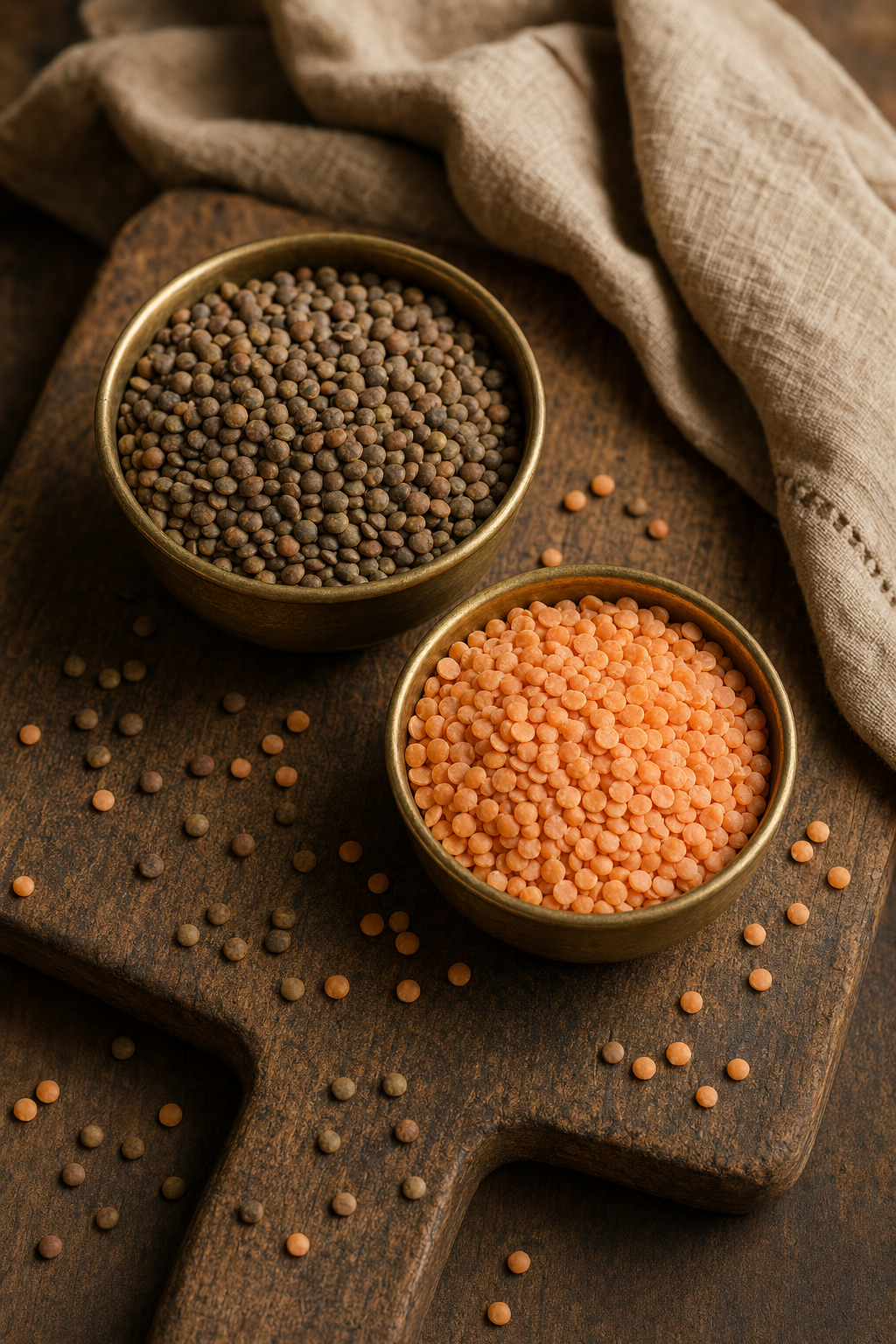
Masoor dal is the Indian name for the red lentil, botanically Lens culinaris, a small lens-shaped legume in the same family as chickpeas and peas. The word "lentil" itself is thought to come from the Latin lens, a reference to the seed’s optical, disc-like shape, the same root that gives us the word for a camera lens. In its raw, whole form the seed has a brownish-grey to olive husk. Split and dehusked, the interior is a warm salmon-orange, which is why English-language packaging almost always calls it "red lentil" even though the outer coat is rarely red at all.
Masoor comes to the table in a handful of distinct forms, and the vocabulary matters because each form cooks and behaves differently:
- Sabut masoor: the whole, unsplit lentil, still wearing its husk. Also called kaali masoor or kali masoor ("black masoor") because the intact husk gives the grain a dark, near-black appearance.
- Dhuli masoor dal, the husk removed and the seed split into two lobes, revealing the orange-pink interior. This is the everyday "masoor dal" most households mean when they say the name without qualification.
- Masoor malka: a specific split-and-polished-free grade, smaller and flatter, prized for its quick cook and delicate colour.
India grows masoor across a well-defined belt: Madhya Pradesh, Uttar Pradesh, Bihar and parts of Rajasthan are the traditional rabi-season heartlands, sown after the monsoon and harvested in spring. Madhya Pradesh alone accounts for a substantial share of national output. Alongside domestic cultivation, India also imports meaningful volumes of lentils from Canada, which has become one of the world’s largest lentil exporters over the past two decades, along with smaller volumes from Australia. Canadian and Australian lentils tend to be more uniform in size because of mechanised, large-scale farming, while Indian-grown masoor, particularly from smaller holdings in MP and UP, shows more natural variation in seed size and colour. Neither origin is inherently superior; the difference shows up mostly in visual uniformity rather than taste, and provenance is worth asking about regardless of where the lentil was grown.
The polishing problem
Walk into most Indian grocery stores and pick up two packets of masoor dal side by side. One will look pale, glassy, almost fluorescent orange under store lighting. The other will look duller, more freckled, with visible variation from grain to grain. The shiny one has, in almost every case, been polished. The duller one has not. This single visual difference is the most important thing to understand before buying masoor dal.
Polishing is a finishing step applied after cleaning, dehusking and splitting, and it exists for one reason: shine sells. There are three common methods used across Indian dal mills.
Water polishing tumbles the split dal with water in a rotating drum, softening and smoothing the cut surface so it reflects light more evenly. Oil polishing does the same with a thin coating of edible oil, usually a cheap refined oil, which gives a glossier, waxier finish and is often preferred by traders because it also slows visible pest activity in storage. Leather polishing, still used in a number of older mills, rubs the dal against a leather belt or leather-wrapped roller inside the polishing drum to buff the surface to a shine. Industry commentary and equipment listings confirm that leather-belt polishers remain part of the pulse-milling supply chain in parts of North India, which is a detail vegetarian and vegan households in particular should know before buying an unlabelled bag of "shiny" dal.
The problem with all three methods is not really the shine. It is what the shine costs. The outer layer of a lentil, the part polishing is designed to smooth away, carries a disproportionate share of the seed’s fibre, B-vitamins and polyphenol compounds such as kaempferol and quercetin. Milling studies on pulse polishing consistently show that the polished product loses fibre and colour compounds compared with the unpolished dal fed into the same machine, and that oil-polished pulses pick up added fat they never had to begin with. None of this improves the eating quality. It improves the shelf appeal on a shop shelf under fluorescent light.
Shine is not a nutrition claim. It is a finishing step, and every finishing step on a pulse mill removes something before it adds anything back.
Aplus Foods does not polish its masoor dal. What leaves our mill is what the lentil actually looks like after cleaning, dehusking and splitting: no water tumbling, no oil coating, no leather buffing. It looks less uniform than the polished dal on a neighbouring shelf. That is the point, not a flaw. You can browse our current range in the Aplus store, and we have written more broadly about why we leave pulses unpolished across our range in our guide to unpolished pulses.
Sabut vs dhuli, a real comparison
The two most common retail forms of masoor are frequently confused, so it’s worth being precise about what separates them.
Sabut kaali masoor is the whole lentil with its husk intact. Because the husk is still there, the grain looks dark brown to near-black from the outside, which is the source of the name "kaali" (black) masoor: a naming quirk that trips up first-time buyers who expect an actually red lentil and find a bag of small, dark, olive-brown seeds instead. Cooked, sabut masoor holds its shape far better than the split version. It has a firmer bite, a slightly earthy, mineral flavour from the retained husk, and a noticeably higher fibre content because the seed coat, the part removed to make dhuli dal, is where much of that fibre lives. It behaves more like a small whole pulse than a lentil in the "quick, creamy dal" sense; it takes longer to soften and benefits from a soak of a few hours, though it still cooks faster than chickpeas or rajma.
Dhuli masoor dal is what results once that husk is removed and the seed is split along its natural seam. This is the form most people picture when they hear "masoor dal": small, flat, salmon-pink lobes that turn a soft yellow-gold as they cook. Dhuli masoor breaks down quickly into a smooth, thick dal without much stirring, needs no soaking, and is ready in fifteen to twenty minutes on a stovetop. Because the fibrous husk has been removed, it is gentler on digestion and easier to combine into khichdi for small children, convalescents or anyone wanting a lighter meal.
The practical distinction, then, is texture and use rather than one being simply "better." Sabut masoor suits dishes where you want the lentil to hold its shape: a chunkier dal, a lentil salad, a slow-cooked one-pot preparation alongside rice. Dhuli masoor suits the everyday tadka dal, thin lentil soups, and quick weeknight cooking where speed matters more than bite. Many Indian kitchens keep both in the pantry for exactly this reason, reaching for one or the other depending on what the meal calls for rather than treating them as interchangeable.
Bold red, small red, malka: a grade explainer
Once a lentil has been split and dehusked, the trade sorts it further into grades that home cooks rarely have explained to them, even though the packet in front of them will usually say "bold," "small," or "malka" somewhere on the label.
Bold masoor refers to the larger-seeded split lentil, typically grown from bigger-seeded varietals or well-developed harvests. It has a slightly firmer texture even after splitting, holds a touch more structure when cooked, and is often preferred by restaurants and larger households for dal preparations that are meant to have some visible body rather than dissolving into a purée. Market listings and commodity-trade reports from mandis routinely price bold masoor as a distinct grade from small masoor, which tells you the trade itself treats size as a meaningful quality marker, not a cosmetic one.
Small masoor is the everyday split lentil most households buy without thinking about grade at all, a mid-sized, quick-cooking split dal that is the default in most Indian kitchens. It cooks a little faster than bold masoor simply because there is less mass per lentil for heat and water to penetrate.
Masoor malka is a distinct product worth understanding on its own terms. Malka is the husk-free, split lentil milled to a smaller, flatter, more delicate form: visually pinker and thinner than standard dhuli masoor, and it cooks down into a particularly smooth, almost velvety dal in a shorter time than either bold or small masoor. Malka is favoured where a fast, light, smooth-textured dal is wanted, such as in a simple weekday tadka dal or a thin lentil soup for someone recovering from illness. It is sometimes conflated with sabut masoor in casual conversation because both carry "masoor" in the name, but they could not be more different: one is whole with husk, the other is the most refined, husk-free split form on the market.
As a simple buying rule: reach for bold masoor when you want body and bite, small masoor for everyday tadka dal, and malka when you want something that cooks fast and finishes smooth: a soup, a khichdi for a child, or a dal you want ready in under fifteen minutes.
Sortex-cleaning and mill hygiene
Before any lentil reaches the polishing question, it passes, or should pass, through cleaning and sorting stages that determine how much stone, husk fragment, insect damage or discoloured grain ends up in the final packet. The term "sortex" comes from Sortex, a long-established manufacturer of optical sorting machinery, and has become shorthand across the Indian pulse trade for optical, camera-based sorting, machines that scan a moving stream of lentils and eject anything that doesn’t match the expected colour or shape profile, catching defects as small as half a millimetre. A dal described as "sortex-cleaned" has been through this optical pass, in addition to the mechanical sieving and gravity separation that removes stones and dust.
Sortex cleaning matters because the alternative, manual or purely mechanical sorting, cannot reliably catch small stones, insect-damaged grains, or foreign seeds that are close in size to the lentil itself. Defect rates in poorly sorted pulses are not a theoretical concern; they are the reason older packets of dal sometimes needed to be picked over, grain by grain, before cooking. A well-run modern mill treats optical sorting as a baseline, not a premium feature.
This is also where certification stops being a marketing sticker and starts being an operational commitment. FSSC 22000, the food safety system certification Aplus Foods holds, alongside US FDA registration and HACCP protocols, requires documented environmental monitoring, hygienic equipment design, and traceable corrective action whenever a batch falls outside specification. In a pulse mill, that translates into practical things: swept and sealed transfer points so lentils aren’t exposed to open dust, verified cleaning logs on polishing and sorting equipment, and pest control zoning that keeps storage separate from processing. None of this is visible in a finished packet of dal. It is visible in whether the mill can show you the paperwork behind it.
There is also a simple test you can run at home that mill hygiene should make unnecessary: the brick-dust test. Adulterating agents, most notoriously powdered brick or synthetic colour, have historically been used to mask poor-quality or damaged lentils and push the colour towards a more "appealing" red-orange. Drop a spoonful of dal into a glass of water and leave it undisturbed for a few minutes. Clean, unadulterated dal will settle with little colour bleed. Water that turns visibly orange, pink, or cloudy, or leaves a gritty, sandy residue at the bottom of the glass, is a signal worth taking seriously.
Nutrition and Ayurveda
Masoor dal is one of the higher-protein pulses commonly eaten in India. Raw, split masoor carries roughly 24–25g of protein per 100g, comparable to urad dal and ahead of moong, toor and chana dal on a like-for-like dry basis, according to India’s Food Composition Tables and cross-referenced USDA data. It is also a strong source of iron, around 6.5–7.6mg per 100g raw: and folate, at roughly 480mcg per 100g, a figure that matters for anyone managing anaemia risk or planning a pregnancy, since folate needs rise sharply at that stage. Cooked values are naturally lower per 100g simply because the lentil absorbs water and roughly doubles in weight during cooking; the protein and iron haven’t disappeared, they are just more dilute per spoonful.
Masoor also sits at the lower end of the glycaemic index scale among common dals, generally cited around 25–30, which is one reason it is often recommended for those managing blood sugar. The fibre in the husk of sabut masoor slows glucose release further, which is a point in favour of keeping the whole form in rotation alongside the split.
In Ayurvedic classification, masoor is generally considered to have a warming (ushna) quality, unlike the cooling profile attributed to moong dal, and is regarded as easy to digest relative to heavier pulses such as chana or rajma. It is frequently recommended in small, well-spiced quantities during recovery from illness, and paired with warming spices such as ginger, asafoetida and black pepper to support digestion further, an old piece of kitchen wisdom that lines up reasonably well with the lentil’s genuinely fast cook time and gentle fibre load in its split form.
Three regional treatments
Few pulses travel across as many regional kitchens as masoor, and it changes character in each.
Punjabi tadka masoor keeps things direct. Dhuli masoor is boiled with turmeric and a little salt until it collapses into a loose, pourable dal, then finished with a hot tadka of ghee, cumin seeds, chopped garlic, dried red chilli and a pinch of asafoetida, poured over the top so it hisses on contact. Onion and tomato are often added to the tadka itself rather than boiled in with the lentils, keeping the base clean and letting the fried aromatics carry the dish. It’s the version most associated with a home-cooked weekday thali across Punjab and Delhi.
Bengali masoor dal takes a sharper, more assertive turn. Mustard oil replaces ghee as the primary fat, heated until it just begins to smoke to mellow its pungency, and the tempering typically uses panchphoran, the five-spice blend of fenugreek, nigella, cumin, fennel and mustard seeds, rather than a simple cumin tadka. A slit green chilli and sometimes a bay leaf go in with the panchphoran, and the dal itself is often kept slightly thinner in consistency than the Punjabi version, closer to a soup that’s eaten with the first course of rice rather than as a thicker accompaniment later in the meal.
Andhra pappu pushes masoor in a sour, spiced direction. Cooked lentils are seasoned with a tempering of mustard seeds, cumin, dried red chillies and curry leaves in oil, then finished with tamarind pulp for a distinct tang, sometimes alongside a chopped tomato or a handful of chopped gourd or spinach cooked into the dal itself. The tamarind is the defining move, it turns a mild lentil into something closer to a lentil-and-vegetable stew with real acidity, eaten with rice and a spoon of ghee stirred through at the table.
How to spot adulteration at home
Three checks cover most of what matters when buying loose or packaged masoor. First, the brick-dust water test described above: cloudy, coloured water or gritty sediment after a few minutes’ soak is a warning sign, not a guarantee of purity if the water stays clear, but a useful first filter. Second, look for colour uniformity that seems too perfect: real, unpolished masoor shows natural variation, some grains slightly darker, some paler, occasional small flecks of husk, because it is an agricultural product, not a manufactured one. A packet where every single lentil is an identical, glassy orange is more likely to have been polished, dyed, or both. Third, avoid dal with an artificial gloss or a slightly oily feel between your fingers; genuine unpolished dal should feel matte and slightly dry to the touch, not slippery.
Frequently asked questions
Does masoor dal need to be soaked before cooking?
Split masoor (dhuli or malka) does not need soaking, a thorough rinse is enough, and it will cook soft in fifteen to twenty minutes. Whole sabut masoor, because the husk is intact, benefits from a soak of two to four hours, which shortens cooking time and improves texture, though it isn’t strictly mandatory.
Is sabut masoor healthier than dhuli masoor, or the other way round?
Neither is simply "healthier", they’re different products. Sabut masoor retains its husk and carries more fibre; dhuli masoor is easier to digest and cooks faster because the fibrous husk has been removed. A pantry with both covers more cooking situations than choosing one over the other permanently.
What is the shelf life of unpolished masoor dal?
Stored correctly, airtight, cool, away from direct light and moisture, unpolished masoor dal generally holds well for six to nine months without meaningful quality loss. Polished dal is often marketed with a longer shelf life, but that extended window has more to do with the surface coating slowing visible pest activity than with any advantage in nutrition or flavour.
How should masoor dal be stored in humid climates?
Humidity is the main enemy of any unpolished pulse, since the intact bran layer can absorb moisture more readily than a polished surface. Use an airtight glass or food-grade steel container rather than the original paper or thin plastic packaging, keep it away from the kitchen counter near a stove or sink, and check periodically for clumping or a musty smell, which signal moisture has gotten in.
Is masoor dal grown in India, or is it mostly imported?
Both. India cultivates significant volumes of masoor domestically, concentrated in Madhya Pradesh, Uttar Pradesh and Bihar, and also imports lentils from Canada and Australia to meet total demand. Origin isn’t a reliable proxy for quality on its own, how the lentil is cleaned, sorted and milled afterwards matters more than where the seed was grown.
Masoor dal rewards attention at the point of purchase more than at the stove, the cooking is genuinely simple once you have the right lentil in the pot. For a closer look at how polishing affects other everyday pulses, our guide to unpolished pulses in India goes further into moong, toor and chana. Our current range of unpolished, sortex-cleaned masoor dal, sabut, dhuli and malka, is available through the Aplus store, and more reading on sourcing and everyday cooking is on the Aplus Foods blog.
See our full unpolished pulses range on the Aplus Foods store.
Premium pulses, dry fruits and more
Shop heritage Aplus Foods products. Free shipping above ₹999. FSSC 22000 · US FDA · HACCP certified.
Browse the Shop →