Authentic Punjabi Dal Tadka: A Home Recipe from Nawanshahr
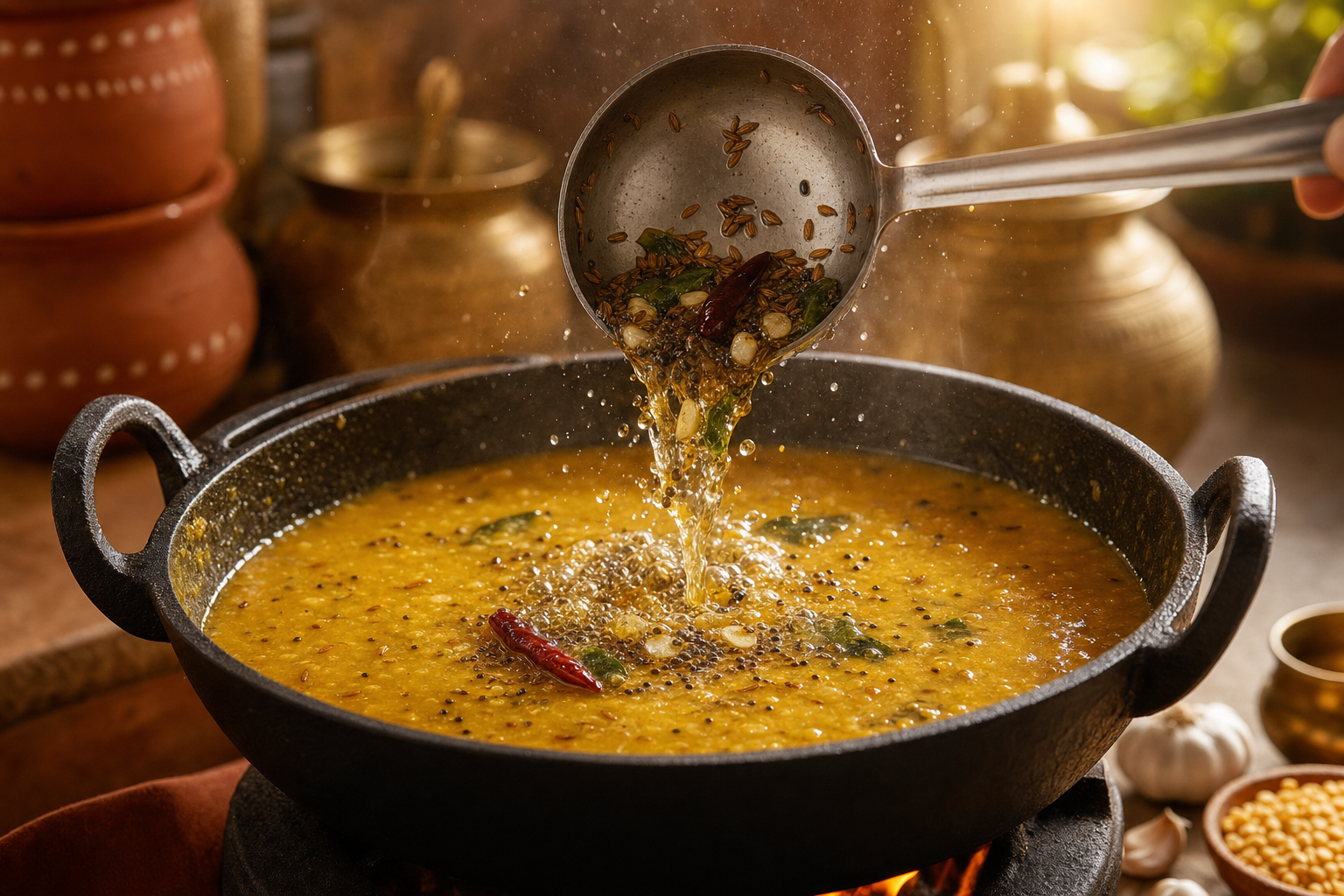
Dal tadka is the most-cooked pulse dish in North India, and the most inconsistently cooked. Half the recipes online tell you to add the tempering into the dal and cook it for five minutes. That’s dal fry. Dal tadka is different: the dal cooks first, the tempering is made separately at the very end, and the tempering is poured over the finished dal at the table. This is the version we cook at home in Nawanshahr, a chana-and-toor combination our family has used for four generations, and the double-tadka technique that gives it the smoky finish you get in a good Punjab roadside dhaba.
Why chana + toor, not just toor
Most dal tadka recipes use only toor dal (split pigeon pea). Toor is soft, sweetish, breaks down completely. That gives you a smooth dal, but a slightly flat one. The trick in a Punjab home kitchen is to run a 3:1 blend of toor and chana dal. The chana dal holds its bite, adds nuttiness, and stops the dal from turning into a homogeneous slurry. You can see individual grains in a good tadka dal. That’s the chana doing its job.
You’ll also see moong dhuli added in some households, that’s fine, it makes the dal lighter. Skip masoor here; it turns the colour muddy.
The ingredient list
For the dal (serves 4):
- ¾ cup toor dal (unpolished, matte golden)
- ¼ cup chana dal (unpolished, matte yellow)
- 1 medium tomato, chopped fine (roughly ½ cup)
- ½ teaspoon turmeric powder
- ½ teaspoon Kashmiri red chilli powder
- 1 teaspoon salt (adjust)
- 3½ cups water
- 1 small piece ginger, grated (about 1 teaspoon)
For tadka #1 (in the dal):
- 1 tablespoon ghee
- ½ teaspoon cumin seeds
- 1 small onion, chopped fine
- 2 cloves garlic, chopped fine
- 1 small green chilli, slit
For tadka #2 (poured on top at the end):
- 2 tablespoons ghee (this is the whole point, don’t skimp)
- 1 teaspoon cumin seeds
- 2 dried Kashmiri red chillies, snapped in half
- 4 cloves garlic, sliced thin
- A pinch of hing (asafoetida)
- ½ teaspoon Kashmiri red chilli powder, added off the heat
- Chopped coriander, for the top
Step 1, Soak the dals
Rinse the toor and chana together in three changes of water until the water runs clear. Cover with fresh water and soak for 30 minutes. This is a small step and everyone skips it. Don’t. Chana dal needs the soak to cook evenly with the softer toor.
Drain the soaking water. This is where a lot of the surface starch (and, if you were unlucky enough to buy polished dal, some of the polish) comes off.
Step 2: Pressure-cook the dal properly
In a pressure cooker, add the soaked dals, 3½ cups fresh water, the chopped tomato, turmeric, chilli powder, salt, and grated ginger. Give it a stir. Close the lid.
Cook on high for the first whistle, then reduce to medium and give it 3 more whistles. Turn off the heat and let the pressure release naturally, do not force it. This is roughly 20–25 minutes on the stove for the whole cook.
When you open the cooker: the toor should have broken down and the chana should still be visible as individual, tender grains. Mash gently with a whisk or the back of a ladle, you want a semi-thick consistency, not a smooth purée. If it’s too thick, add half a cup of hot water and stir. Adjust salt.
Step 3, Tadka #1 (into the dal)
In a small pan, heat 1 tablespoon of ghee. Add the ½ teaspoon cumin. When it splutters (5 seconds), add the chopped onion and cook for 3 minutes until golden at the edges. Add the chopped garlic and slit green chilli, cook another 30 seconds.
Pour this whole tadka into the cooked dal, stir once, and simmer the dal for 3–4 minutes on low. The onion and garlic dissolve into the dal, giving it a base sweetness.
At this point the dal is finished. Pour it into a serving kadhai or a small handi. Keep it hot.
Step 4, Tadka #2 (the one that matters)
In a small ladle or a tadka pan, heat 2 tablespoons of ghee on medium-high until it shimmers, you want it hot but not smoking. Add the 1 teaspoon cumin. Wait 3 seconds. Add the snapped dried red chillies. They will darken almost immediately. Add the sliced garlic, it should turn deep gold in 15 seconds, don’t let it burn. Add the pinch of hing.
Take the ladle off the heat. Now, off the heat, add the ½ teaspoon of Kashmiri chilli powder. This is the critical step. If you add chilli powder onto direct heat it burns and turns bitter. Off the heat, it blooms into red-orange oil in 2 seconds without burning.
Immediately pour the whole tadka over the waiting dal. It will hiss. It will smoke a little. That hiss is the sound of a good tadka dal. Sprinkle chopped coriander on top. Do not stir it in. Serve immediately.
Step 5 (optional), The dhungar smoke finish
This is what makes a dhaba dal taste like a dhaba dal. Take a small piece of hot charcoal (a natural lump charcoal, not briquette). Place it in a small steel bowl set inside your dal kadhai. Drop a teaspoon of ghee on the hot charcoal, it will smoke immediately. Cover the kadhai with a lid for 3 minutes. Remove the bowl and the charcoal. Your dal is now infused with a smoky note that no tadka can give it.
This is optional. Most days we don’t do it. On Sundays we do.
What to eat it with
Steamed basmati rice. Or fresh, hot phulka rotis brushed with a slick of ghee. A side of sliced onion and green chilli. A wedge of lemon on the side: the lemon isn’t for taste, it’s for iron absorption, but it also lifts the whole plate.
The small things that separate good dal tadka from great
- Unpolished dals. Polished dals cook to a slightly gummy finish. Unpolished dals stay grainy and honest.
- Ghee, not oil. Every attempt to make dal tadka with vegetable oil produces a dal that tastes flat. Ghee is not a suggestion. It’s the point.
- Whole cumin, whole chilli. Powdered cumin will not give you the same aroma. Whole seeds bloom in hot fat.
- Chilli powder off the heat. Bitter tadka is almost always burnt chilli powder. Off-heat solves it.
- Serve the tadka hissing. Made in advance, cooled, reheated tadka dal is a different, worse dish. The tadka goes on last, the dal goes to the table smoking.
What we use at home
The dals we cook this recipe with, both the toor and the chana, come from our own Aplus mill in Nawanshahr, unpolished, FSSC 22000, US FDA registered, HACCP audited. The ghee is desi cow ghee from a small dairy 40 km from the mill. The Kashmiri chilli powder is stone-ground, not machine-heated, so it holds its colour. None of these are branded plugs, they’re the actual bill of materials for a Sunday afternoon lunch in a Punjab family kitchen. Use whatever versions of these you trust; the technique matters more than the labels.
Related reading
Premium pulses, dry fruits and more
Unpolished pulses, honestly graded dry fruits, and single-source spices, milled and packed in Nawanshahr, Punjab. FSSC 22000, US FDA and HACCP certified.
Browse the Shop →