Unpolished vs Polished Dal: A Visual Buyer’s Guide
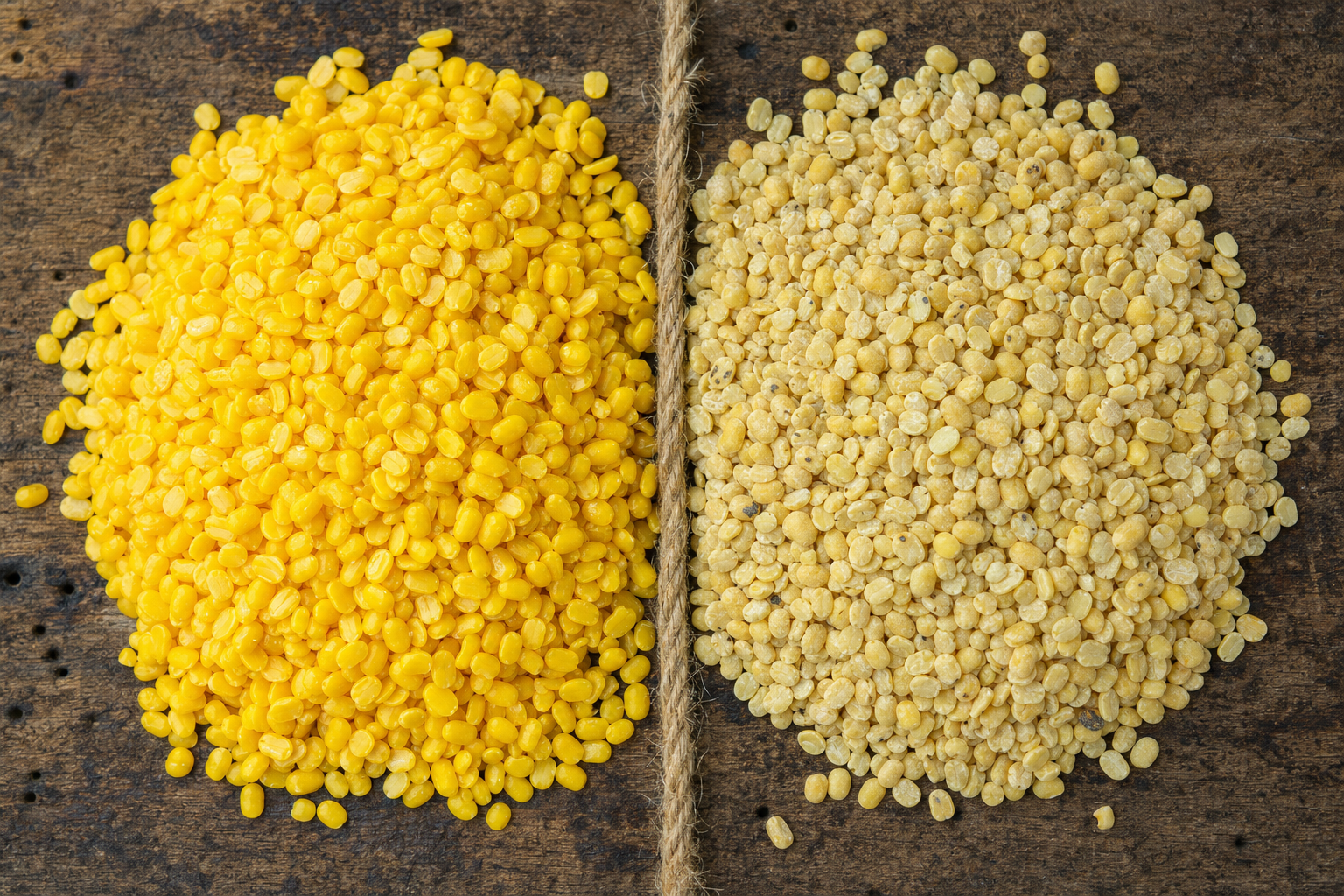
Two packets of moong dal on a shelf. Same weight, same brand tier, priced within ₹15 of each other. One glows a bright canary yellow, one looks a little duller. Nine out of ten Indian shoppers pick up the glossy one, because it looks "cleaner". They are picking up the polished one. This piece is the two-minute visual test that flips that instinct.
What "polished" actually means
After a dal is dehusked and split, the mill has a choice. Ship it as-is: matte, faintly dusty, slightly variable in shade. Or run it through a finishing step that makes it uniform and shiny. That finishing step is what "polishing" refers to.
Four polishing methods are used in Indian pulse mills, in decreasing order of legitimacy:
- Water polishing. A fine mist wash followed by rotary drum drying. Legal, gentle, but strips a thin layer of the cotyledon along with any surface starch.
- Leather buffing with a trace of vegetable oil. Traditional. Gives the classic shine. Legal. Adds a very small amount of oil to the surface.
- Soap-stone / talc polishing. Adds a mineral powder that buffs the surface. FSSAI has flagged this in guidance because talc residue is not something you want to eat.
- Mineral oil polishing. Explicitly banned. Uses a food-grade mineral oil coating to make the grain shine. Still used in the grey market because it’s cheap.
You cannot, standing in an aisle, tell method #2 from method #4. What you can tell is that some polishing was done. That’s the visual test.
The visual cues, side by side
For any dal, moong, masoor, chana, urad, toor, the same six differences hold:
- Surface finish. Unpolished is matte, sometimes lightly dusty. Polished is glossy, almost wet-looking.
- Colour saturation. Unpolished is a softer, more muted shade. Polished is more saturated: brighter yellow, brighter pink, brighter orange.
- Colour uniformity within a lot. Unpolished shows tiny natural variation from grain to grain. Polished is unnaturally uniform, like coloured plastic.
- Edge definition. Unpolished split dal has slightly rough, natural edges. Polished has smooth, almost machined edges.
- Behaviour on a paper napkin. Rub a small handful of dal on a white napkin for 10 seconds. Unpolished leaves nothing visible. Polished leaves a coloured smear or a slight greasy patch.
- Behaviour in wash water. Rinse a cup in clear water. Unpolished makes the water cloudy but colourless. Polished makes the water yellow, pink, or orange within seconds.
The two tests you can do at home in 60 seconds
Test 1: The paper test
Take a small handful of dal, place it in the middle of a folded white paper napkin, and rub firmly with your fingertips for 10 seconds. Open the napkin.
Unpolished: The napkin is still white. Maybe a faint dust smear.
Polished: A visible yellow, pink or orange smear. If there’s also a slight translucent oil patch, it was oil-polished.
Test 2, The wash-water test
Put half a cup of dal in a clear bowl. Add two cups of tap water. Swirl gently for 15 seconds. Pour the water off into a clear glass.
Unpolished: Water is cloudy (that’s starch, normal) but colourless.
Polished: Water is coloured: yellow for moong, pink-orange for masoor, deep yellow for chana, or has a soapy film. All three are a sign of polishing.
Rinse twice more and the colour usually fades. That does not mean the coating is gone from every grain, it means the loose surface layer has washed off. The rest cooks into your food.
The comparison, dal by dal
Not every polished dal looks the same. Here’s what to look for in the five most common Indian pulses:
- Moong dal dhuli (yellow split). Unpolished is pale, matte, almost creamy yellow. Polished is bright canary yellow, glossy. This is the easiest polishing to spot.
- Masoor dal (red split). Unpolished is a soft matte coral. Polished is bright orange, almost fluorescent under supermarket lights.
- Chana dal (Bengal gram split). Unpolished is dull mustard-yellow. Polished is deep golden with a shine.
- Toor dal (split pigeon pea). Unpolished is a warm, uneven golden-brown. Polished is bright yellow-gold with visible shine. Toor is one of the most commonly polished dals in India.
- Urad dal dhuli (white split). Unpolished is a soft off-white to ivory. Polished is stark white, sometimes bluish-white.
Why polished dal exists at all, a fair steelman
Polishing isn’t purely a scam. It exists because:
- It makes the grain visually uniform, which reduces "does this dal look bad?" returns from retailers.
- Water polishing improves shelf-life marginally by removing surface starch that insects feed on.
- Consumer conditioning, decades of glossy dal on TV and packaging, means unpolished dal is now perceived as "old" or "dirty" by first-time buyers.
Those are real reasons. But once you know the visual cues, they stop feeling like reasons. A dull matte dal is not "old". It’s honest.
The nutritional cost of polishing
Polishing removes a thin layer of the cotyledon along with any surface starch. Studies from the Indian Institute of Pulses Research put the loss at roughly 10–15% of surface B-vitamins, 5–8% of fibre, and a small loss of surface protein. This is not catastrophic, it’s not the difference between white rice and brown rice. But it’s a real, avoidable loss for no cooking benefit.
The bigger issue is what’s added, not what’s lost. Talc residue and mineral oil coatings are not things you want in your daily dal, even at trace levels.
What Aplus Foods does, and doesn’t do
Under both the Aplus and Healthy House brands, our pulses ship unpolished. No talc, no soap-stone, no oil buffing, no mineral oil coat. The packet says "unpolished" on the front. Facilities are FSSC 22000, US FDA registered, HACCP audited. If you run the paper test on our masoor, moong, chana or urad, the napkin stays white. If you run the wash test, the water stays colourless.
That’s the whole product claim. There is no other trick.
The one-sentence rule
If the packet looks like the "before" photo in a cleaning product ad, it’s polished. If it looks like the "after" photo of the same ad, it’s polished. If it looks like something a mill would pour into a bag without stopping to make it pretty, that’s the one.
Related reading
Premium pulses, dry fruits and more
Unpolished pulses, honestly graded dry fruits, and single-source spices, milled and packed in Nawanshahr, Punjab. FSSC 22000, US FDA and HACCP certified.
Browse the Shop →