Chana Dal: The Complete Guide to India’s Split Bengal Gram
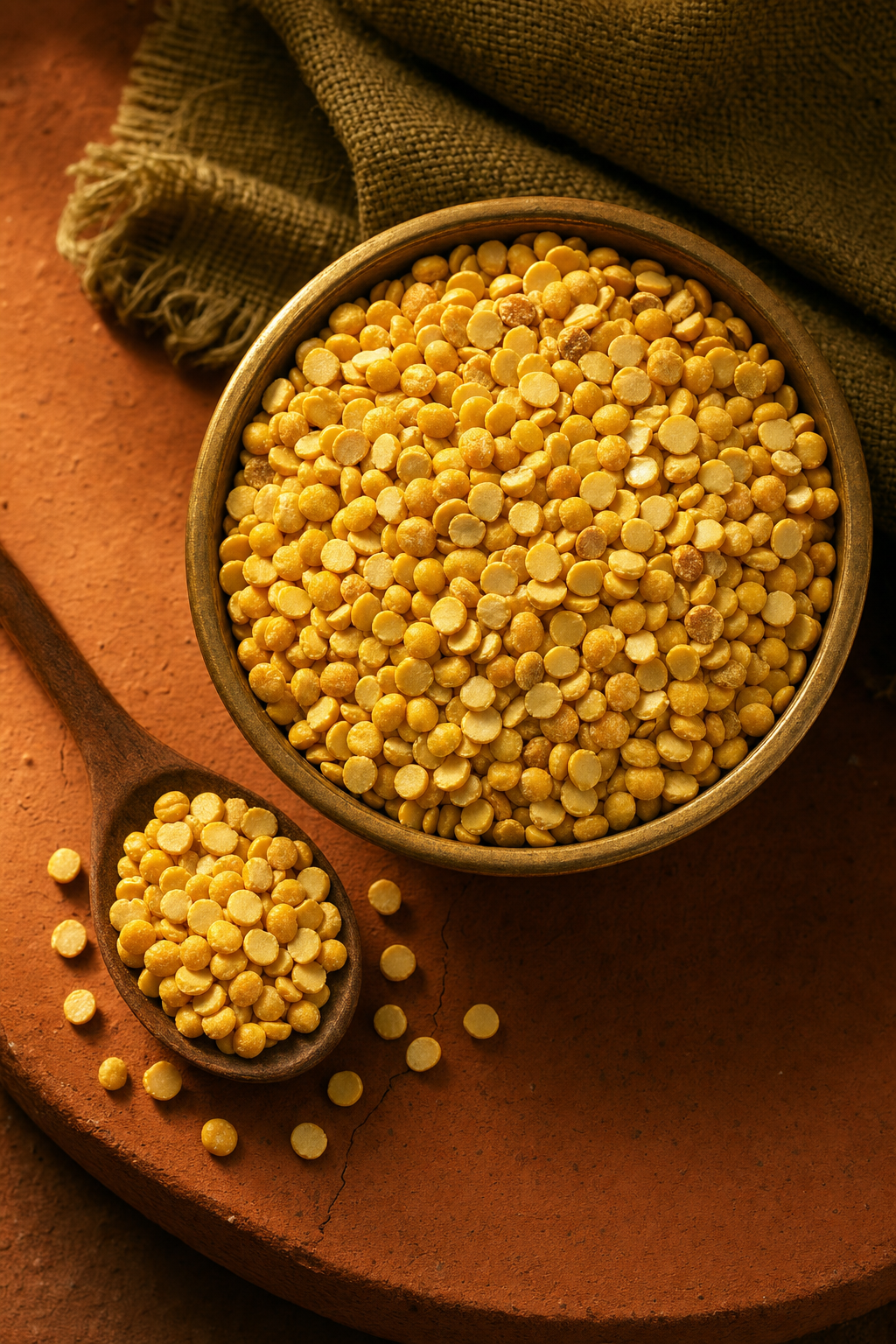
Chana dal is one of the two or three pulses that hold Indian cooking together: sambhar tempering, bhindi masala thickener, Punjabi Sunday khichdi, roasted chanachur at 4 pm. But most Indian shoppers cannot cleanly answer three basic questions about it: what plant does it come from, why is it yellow inside when a chickpea is beige outside, and why does the cheap polished version look glossier than the honest one?
This is a sourcing-first guide. If you cook chana dal a couple of times a week, or you buy it in 5 kg sacks for a canteen, the next 1,600 words will change what you look for on the label.
What chana dal actually is
Chana dal is the split, dehusked, dried seed of the desi chickpea: Cicer arietinum, the small brown-black chickpea grown across Rajasthan, Madhya Pradesh, Maharashtra and Karnataka. When you pull the dark outer husk off a whole kala chana (also called sabut chana), what’s inside is a pale yellow cotyledon. Split that cotyledon down the middle and you get chana dal, two flat, matte-yellow halves per seed.
This is very different from the other chickpea you know: kabuli chana, the large cream-white chickpea used in chole, hummus and salads. Kabuli is a separate variety of the same species, grown mostly in the Deccan and imported in bulk from Australia and Canada. Kabuli chana is almost never made into a dhuli (dehusked) dal in India because the seeds are too large and the yield is low. When a recipe calls for chana dal, it means the yellow split, from desi chana, not kabuli.
Sabut chana → chana dal: the milling journey
Chana dal doesn’t come off the plant looking like this. It’s the end product of a five-step mill process:
- Cleaning. Whole desi chana comes into the mill with stones, sticks, damaged seeds and dust. It goes through a de-stoner, magnetic separator, and gravity table.
- Conditioning. The seeds are lightly moisture-conditioned, sometimes with a thin oil coating, sometimes just water, so the husk loosens and the cotyledon doesn’t shatter.
- Dehusking. An emery roller mill scrapes the dark outer husk off. What comes out is called chilka chana or gota: whole, dehusked, still round.
- Splitting. The gota is passed through a splitter that cracks each seed into two halves along its natural cotyledon line. This is what makes it dal.
- Grading and finishing. The split is sieved, aspirated to remove husk fragments, then bagged. This is where honest mills stop, and where dishonest mills start polishing.
The polishing problem: and how to spot it
Freshly milled, honest chana dal is a soft, matte yellow. It looks a bit dusty. It has a faint earthy smell. When you rub two grains between your fingers there is no residue.
Polished chana dal looks completely different. It is bright yellow, sometimes almost golden. It shines under a supermarket light. It looks, this is the point, "cleaner". That shine comes from one of three things: a water-and-talc wash, a soap-stone polish, or a light coat of vegetable oil buffed with leather. The FSSAI has flagged all three practices, and mineral oil polish is explicitly illegal.
Two easy at-home tests:
- The paper test. Rub a handful of dal on a white sheet of paper for ten seconds. Honest dal leaves almost nothing. Polished dal leaves a yellow smear or a greasy film.
- The wash-water test. Rinse a cup of dal in a bowl of clean water and swirl. Honest dal makes the water cloudy but colourless. Polished dal turns the water pale yellow, sometimes soapy.
Unpolished chana dal cooks faster than polished (the outer surface hasn’t been sealed), soaks up masala better, and gives your dal a proper thick body without adding besan or cream.
Chana dal vs the other yellow dals
People confuse chana dal with two other yellow pulses at the shop counter: toor dal (arhar / split pigeon pea) and moong dal dhuli (dehusked yellow split mung). Here is the honest difference table:
- Chana dal: flatter, larger grain (5–7 mm across), matte pale yellow, holds its shape when cooked, nutty flavour, needs a pressure cooker or long soak.
- Toor dal: smaller (4–5 mm), slightly domed, deeper golden yellow, breaks down into a soft mash, mildly sweet, is the base of Gujarati and South Indian dals.
- Moong dal dhuli: smallest (3–4 mm), oval, palest yellow, cooks in 15 minutes without soaking, delicate flavour, is the standard "khichdi" dal.
You cannot substitute one for the other without changing the character of the dish. A tadka wali dal made with chana dal has bite. The same recipe with toor dal is soft and slurpy. The same with moong dhuli is thin.
Nutrition: why chana dal punches above its weight
Per 100 g of dry, uncooked chana dal you’re looking at roughly 22 g of protein, 11 g of dietary fibre, 60 g of complex carbohydrate and around 350 kcal. Two numbers matter more than the rest.
First, the glycaemic index. Chana dal sits at a GI of about 8, one of the lowest of any commonly eaten carbohydrate food in India. This is why diabetologists across the country tell patients to swap a portion of their evening rice for a bowl of chana dal khichdi. The starch is packaged with fibre and resistant starch, and it releases slowly.
Second, the protein completeness. Like all pulses, chana dal is short on the amino acid methionine but rich in lysine. Roti and rice, the two things you eat with dal, are the opposite. That’s not an accident. The dal-chawal or dal-roti combination is a complete-protein meal by design, and it has been for four thousand years.
Iron is where chana dal often gets over-claimed. Yes, it has about 5 mg per 100 g dry, but non-heme iron absorbs at 2–5% unless you eat it with a vitamin C source. A squeeze of lemon on your dal is doing more work than most people realise.
How to buy chana dal properly
Six things to read on a label or ask a shopkeeper before you buy:
- Unpolished, mentioned in writing. If the packet doesn’t say "unpolished", assume it’s polished. Honest brands make a point of it.
- Certifications beyond FSSAI. FSSAI is the baseline every registered food business has. The signals that matter are FSSC 22000, US FDA registration, or HACCP, those mean a real audited food-safety management system, not a licence.
- Pack date, not just expiry. Chana dal is fine for 8–10 months from milling. A recently packed dal cooks more evenly and tastes cleaner.
- Grain uniformity. Turn the packet over. If half the grains are large and half are small chips, the mill isn’t grading properly.
- Colour consistency. A single lot should be one shade. Two-tone dal usually means blending old and new stock.
- Country/state of origin. Madhya Pradesh and Rajasthan give the cleanest desi chana harvests. Imported (Australian) desi chana is fine, but ask.
Cooking chana dal properly
Chana dal is one of the few dals that genuinely rewards a soak. Two hours in warm water cuts your pressure-cooker time in half and gives you a creamier finish. Skip the soak and you will need 5–6 whistles instead of 3.
Ratios that work: 1 cup dal to 3 cups water for a thick dal fry, 1 cup dal to 4 cups water for a dal you serve with rice, 1 cup dal to 5 cups water for a khichdi. Salt goes in before pressure cooking, it will not stop the dal from softening, contrary to grandmother lore.
The tempering (tadka) is what separates a canteen dal from a good one. Ghee, hot until it shimmers, then cumin, then dried red chilli, then a whisper of hing, then garlic if you like, then chopped tomato. Poured over the finished dal, not cooked into it.
Where Aplus Foods stands on chana dal
Our chana dal is milled from desi chana lots sourced out of Madhya Pradesh and Rajasthan, dehusked and split without any polishing step, no talc, no soap-stone, no oil buffing. It ships FSSC 22000, US FDA registered, HACCP audited. The packet says "unpolished" because it is.
If you’re comparing packets on a shelf and both cost roughly the same, buy the duller one. That’s the honest one.
Related reading
- Unpolished Masoor Dal, The Complete Guide to India’s Red Lentil, the sister pillar to this post, same sourcing lens applied to red lentil.
- Unpolished vs Polished Dal, A Visual Guide, the paper test and the wash-water test with photographs.
- Authentic Punjabi Dal Tadka Recipe, the chana dal + toor dal combination our family has cooked at home in Nawanshahr for four generations.
Premium pulses, dry fruits and more
Unpolished pulses, honestly graded dry fruits, and single-source spices, milled and packed in Nawanshahr, Punjab. FSSC 22000, US FDA and HACCP certified.
Browse the Shop →