Phool Makhana from Bihar: The Definitive Guide to India’s Premium Fox Nut
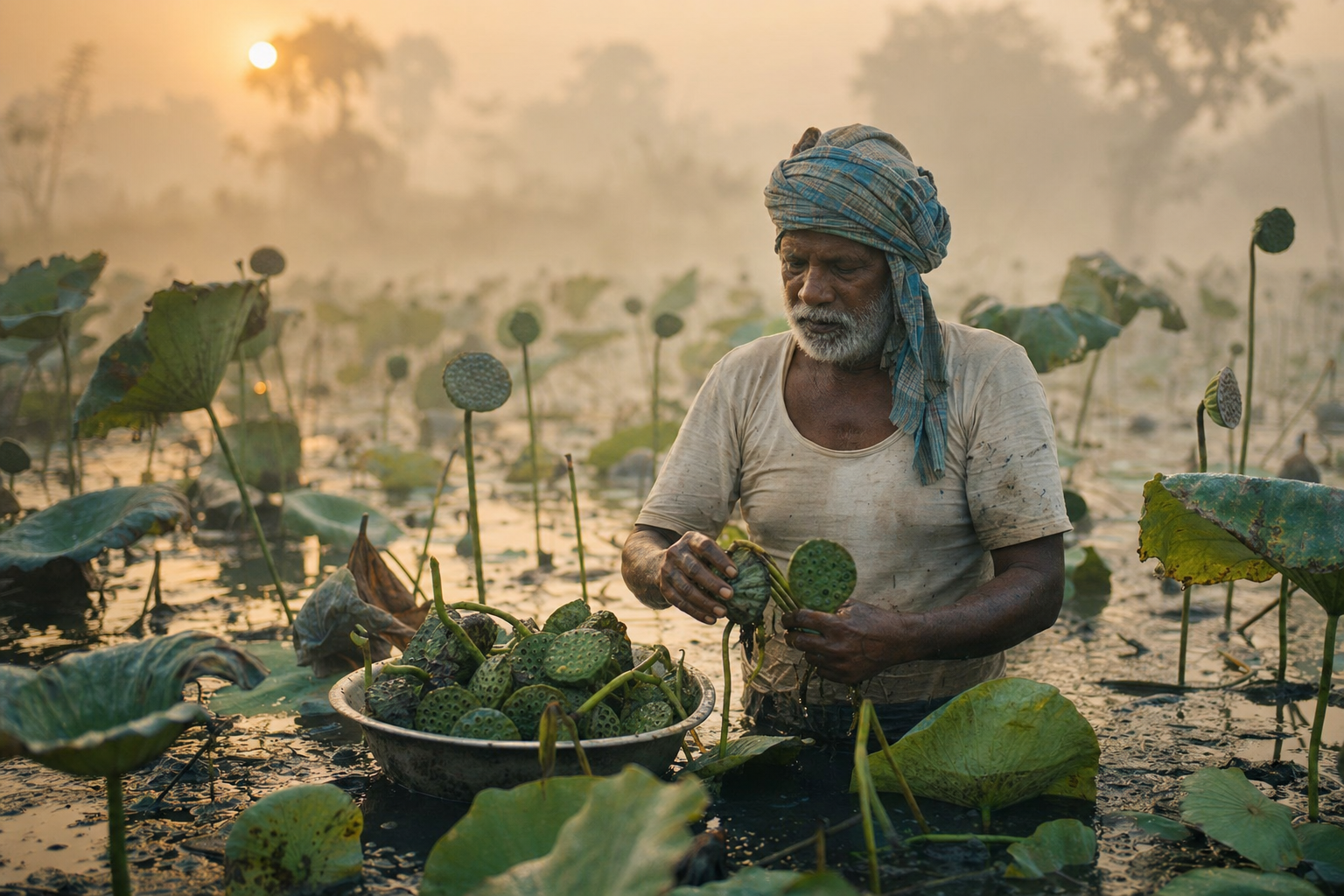
Before dawn in Mithila, the ponds are already busy. Women wade waist-deep into still, dark water, feeling for ripened seed pods with their bare feet, while the mist over Darbhanga and Madhubani has not yet lifted. This is the harvest of phool makhana, fox nut, and it has looked more or less the same for generations.
The lotus that yields makhana, Euryale ferox, does not grow in tidy rows. It grows wild-tempered, thorned, and stubborn, in the flood-fed ponds of a region that has quietly supplied most of the world’s fox nut for as long as anyone can remember. What reaches a shelf as a pale, puffed, faintly nutty snack began life as a black seed prised from the bed of a pond, roasted over a wood fire, and struck by hand until it burst.
This guide is for the reader who wants to understand makhana properly: where it is grown, how it is graded, what "4-suta" actually means, and how to tell a well-made batch from an indifferent one. We source ours from single villages in Bihar’s Mithila belt, and we think the story is worth knowing before the snack ever reaches your bowl.
What is phool makhana, exactly?
Phool makhana, also called fox nut, lotus seed, or gorgon nut in different markets, is the puffed, popped seed of Euryale ferox, a prickly water lily native to the still ponds and wetlands of eastern India, parts of China, Korea, and Japan. It is not a nut in the botanical sense at all. It is an aquatic seed, harvested from a plant that behaves more like a stubborn weed than a cultivated crop.
The plant itself is striking: broad, spiky leaves float on the pond surface, and the flowers, usually violet or purple, close each evening and reopen the next day, eventually giving way to a spiny fruit that holds the seeds. Left alone, Euryale ferox would simply seed the pond again the following season. Farming families intervene at exactly the right moment, harvesting the seed pods before they can fall and scatter.
Why does it puff?
The raw seed is small, round, and hard as gravel, nothing like the airy, honeycombed snack most people know. Puffing happens through a controlled heat shock: the dried seed is roasted in a heavy iron pan over a wood or coal fire until the internal moisture turns to steam, and the outer shell is struck sharply so the kernel bursts outward into its familiar popped form. It is closer to popcorn than to any tree nut, and the process is still substantially manual in the Mithila belt.
Each seed passes through harvesting, sun-drying, grading by size, roasting in batches, and hand-popping before it is ready for cleaning and packing. It is a slow, seasonal food, and that is part of what gives well-made makhana its character.
From pond to pantry: the basic journey
The plant is typically sown in February or March and harvested through the monsoon months into early autumn, with pickers wading into ponds repeatedly across the season as pods ripen at different times. Once collected, the black seeds are separated from their spiny pods, washed, and left to dry in the sun for several days until the outer shell hardens.
The dried seed then goes through a preliminary sorting by size before roasting. This is skilled, physically demanding work passed down within families, and it is one reason makhana has remained a smallholder-led crop rather than a fully mechanised one, even as demand has grown well beyond Bihar’s borders.
Why Bihar grows nearly all the world’s makhana
Roughly 80–90 percent of the world’s makhana comes from a fairly compact stretch of north Bihar: the districts of Darbhanga, Madhubani, Purnia, Katihar, Saharsa, and Sitamarhi, collectively known as the Mithila and Kosi-Seemanchal region (The Hindu; Agro-Economic Research Centre, Bhagalpur). This is not a coincidence of climate alone. It is the product of a specific hydrology, shallow, flood-prone ponds that hold water for most of the year, and generations of a very particular kind of farming knowledge.
Mithila, the cultural region straddling northern Bihar and the Nepal tarai, has grown makhana in its ponds for centuries, historically alongside pisciculture. Fisherfolk communities would harvest fish and makhana from the same water bodies, treating the lotus seed as a secondary crop until demand and better processing turned it into a primary one. The skill of diving for seed pods, judging ripeness by touch, and hand-popping seed without shattering the kernel is not something that transfers easily outside these villages.
A geographical indication, not just a growing region
In August 2022, Mithila Makhana was awarded a Geographical Indication (GI) tag by the Government of India: the fifth product from Bihar to receive one, following Shahi Litchi, Katarni rice, Magahi paan, and Zardalu mango (The Indian Express). The tag is registered in the name of the Mithilanchal Makhana Utpadak Sangh, based in Purnia, and is valid for ten years before renewal.
A GI tag works much like it does for Champagne or Darjeeling tea: it legally protects the name so that only makhana genuinely grown within the defined Mithila belt can be marketed under it. For a buyer, this matters less as a legal technicality and more as a provenance signal: it confirms that what you are eating grew in the specific ponds, soil, and water chemistry that this snack has always been associated with.
Other pockets of India, parts of Assam, Manipur, and small patches elsewhere, do grow Euryale ferox, and imported fox nut also enters the market from China and Korea. None of it carries the weight, or the flavour consistency, that Mithila’s ponds have built up over generations of specialised cultivation.
The grading you must understand: suta explained
If you have shopped for makhana before, you may have seen packaging mention "4-suta" or "5-suta" without much explanation. Suta is the traditional unit Bihar’s makhana trade uses to grade popped seed by size, and understanding it is the single most useful thing you can learn before buying.
One suta is roughly 3.1–3.2 millimetres. The suta number tells you the approximate diameter of an individual popped kernel, measured in multiples of that unit. A higher suta number means a larger, rounder, more fully puffed kernel: and, generally, a more consistent, more premium grade.
The suta scale in practice
- 3-suta: roughly 9–11mm. Small, often broken or partially popped kernels, typically diverted to grinding, flour, or industrial use rather than snacking.
- 4-suta: roughly 12–15mm. This is the benchmark premium snacking grade: round, evenly popped, with a good balance of size and crunch. Most quality-focused retail brands, ours included, work with 4-suta and above.
- 5-suta: roughly 15–18mm. Larger, fluffier kernels, often preferred for gifting packs and export-facing retail.
- 6-suta and above: 18mm and upward, sometimes reaching 21–23mm for jumbo lots. These are the rarest, most visually striking kernels, generally reserved for premium gifting and specialty export orders.
The grading is not arbitrary. Larger suta kernels have puffed more completely, which usually means a lighter, airier bite and a cleaner snap. Smaller suta kernels tend to be denser and slightly chewier: not inferior in nutrition, but different in mouthfeel, and rarely what a discerning snacker is looking for.
How to check suta from packaging
Reputable makhana packaging will state the suta grade directly, often alongside a size range in millimetres. If a pack simply says "premium makhana" with no suta reference, treat that as a gap in transparency rather than a guarantee of quality. A genuinely graded pack should also show reasonably uniform kernel size when you look through the packet, a mix of very large and very small pieces in the same bag suggests the batch was not properly sorted.
A kernel’s suta number is not a marketing flourish, it is the closest thing makhana has to a size and quality passport, inherited from a grading system that predates any of today’s packaging.
Sortex-cleaning and hand-sorting: the quiet quality step
Once makhana is popped and graded by suta, it still carries husk fragments, discoloured pieces, and stones picked up during open-air drying. This is where optical sorting, commonly known by the trade name Sortex, comes in.
A Sortex machine passes the popped kernels past high-resolution cameras that detect colour deviation, discolouration, and foreign matter, ejecting anything that falls outside an acceptable colour band using precise air jets. For a food that is judged partly by eye, colour uniformity is one of the fastest signals of quality a shopper can use, this step is not cosmetic. It is a genuine food-safety and consistency control.
What defect rates look like
In a well-run facility, optical sorting followed by a manual hand-check should bring visible defects, dark spots, husk fragments, foreign particles, down to a very small fraction of the batch, typically well under two percent by weight. Broken-kernel content above roughly ten percent in a retail pack is generally considered a sign of rough handling or a skipped sorting step, and is worth avoiding.
Colour uniformity deserves particular attention. Good makhana should read as consistently ivory-to-cream across the pack, without the scorched, brownish flecks that indicate uneven roasting temperatures. A pack with wildly inconsistent colour has usually skipped hand-sorting altogether.
This is one of the reasons we favour single-village sourcing lots wherever a season allows it: a batch drawn from one grower, one pond, and one roasting setup is inherently easier to keep colour-consistent than makhana blended from multiple, unrelated sources.
Why hand-sorting still matters alongside machines
Optical sorters are excellent at catching colour deviation, but they are less reliable at judging texture, subtle cracks, or the very fine husk fragments that occasionally slip through. A final manual check, done by trained hands running through trays of sorted kernels, remains standard practice at facilities that take grading seriously.
The combination of machine and human judgement is what separates a merely acceptable batch from a genuinely premium one, and it is also slower and more expensive than relying on machine sorting alone, which is precisely why so many mass-market packs skip the second step.
Nutrition and Ayurvedic value
Set against most packaged snacks, makhana’s nutrition profile is genuinely unusual. Per 100g of raw, popped kernels, you are typically looking at around 347–356 kcal, 9–10g of protein, roughly 77g of carbohydrate, 12–14g of dietary fibre, and under 1g of fat (PharmEasy). That is a rare combination, a near-fat-free food that is simultaneously high in fibre and reasonably protein-dense for a plant source.
It also carries meaningful calcium (around 60mg per 100g), magnesium (55–90mg), potassium (roughly 350–500mg), and modest iron, a mineral profile that has made it a long-standing staple in Indian diets that need to be light on the stomach but still nutrient-dense.
Makhana’s glycaemic index is comparatively low, generally cited around the mid-40s, which is one reason it appears so often in diabetic-friendly and weight-conscious meal plans across Indian nutrition advice. Its carbohydrate is largely complex and paired with a high fibre load, which slows the rate of glucose release compared with more refined snacks.
Where Ayurveda places it
In Ayurvedic thinking, makhana is generally classified as sweet, cooling, and easy to digest: qualities associated with pacifying vata dosha, the constitution linked to dryness, irregularity, and nervous energy. It is commonly recommended in kheer form during postpartum recovery and while breastfeeding, on the understanding that it is nourishing without being heavy, and gentle on a digestive system that needs rebuilding.
This is also why makhana shows up so consistently at Indian festivals and religious fasting days (vrat), it is considered a "clean," easily digestible food suited to periods when heavier grains are avoided. None of this displaces modern nutrition science, but it does explain why the snack has held cultural ground for so long, well before it became a wellness-aisle staple.
How to roast makhana properly at home
Most packaged makhana still benefits from a home roast, whether you are working with raw popped kernels or simply refreshing a pack that has softened slightly in transit. The two broad approaches are dry roasting and ghee roasting, and each suits a different outcome.
Dry roasting
Dry roasting is the lighter, more diet-conscious method. Use a heavy-bottomed pan on low-to-medium heat, too high, and the kernels scorch on the outside while staying soft within. Add the makhana in a single layer, and stir continuously for eight to ten minutes, listening for the sound to change from a dull rattle to a lighter, crisper clatter. That shift in sound is your most reliable doneness cue, more useful than colour alone.
Ghee roasting
For a richer, more indulgent result, roast in a spoon or two of ghee over low heat. The fat helps spices and salt adhere properly and gives the kernel a rounder, less austere flavour. Keep the heat gentle, ghee scorches faster than you expect, and burnt ghee will taint the whole batch with a bitter note that no seasoning can mask.
Timing and temperature, in short
Regardless of method, low and slow beats hot and fast. A pan that is too hot will crisp the surface before the moisture inside has fully escaped, leaving kernels that turn chewy rather than crunchy as they cool. Ten minutes on a moderate flame, stirred often, is a safer target than five minutes on high heat.
Flavour pairings worth trying
Once roasted, makhana takes seasoning well because of its naturally neutral, faintly nutty base flavour. A few combinations worth exploring at home:
- Peri-peri: a light oil base, peri-peri masala, and a finishing pinch of chaat masala for tang.
- Tomato: tomato powder or ketchup-based seasoning blends, finished while the kernels are still warm so the coating clings.
- Cheese: a dusting of cheese powder works best on ghee-roasted batches, where the fat helps the coating stick evenly.
- Kesar-elaichi: a sweet variation using saffron strands warmed briefly in ghee with cardamom powder and a little jaggery or sugar, closer to a festive treat than a savoury snack.
How to spot inferior makhana
Not all makhana on the market is graded, sorted, or roasted with equal care, and a few simple checks will tell you most of what you need to know before you commit to a pack.
Broken pieces
Look through the pack, if the packaging allows it, or check the product description for a stated breakage percentage. Anything above roughly ten percent broken or fragmented kernels suggests rough handling somewhere between popping and packing.
Colour spots
Dark scorch marks or uneven brown patches usually point to inconsistent roasting temperatures, or a batch that skipped optical sorting. Good makhana should look close to uniformly ivory or pale cream across the pack.
The brittleness test
Snap a kernel between your fingers. It should break cleanly with a light, crisp sound. A kernel that bends, feels rubbery, or crumbles into dust rather than snapping has usually absorbed moisture, or was never dried to the correct point in the first place.
The aroma test
Fresh makhana carries a faint, clean, toasty smell, close to lightly roasted grain. A musty, stale, or flat smell is an early sign of moisture ingress or age, well before you can taste it.
Bitter aftertaste from over-drying
Occasionally, makhana that has been dried or roasted at too high a temperature for too long develops a faint bitterness at the back of the palate. This is a processing fault, not a natural characteristic of the seed, and is one more reason temperature control during roasting matters as much as sourcing.
Our sourcing story
Aplus Foods has been a family-run food house since 1958, working out of Nawanshahr, Punjab, and our approach to makhana follows the same principle we apply to everything else on our shelves: know exactly where it came from.
Where a season allows it, we work with single-village sourcing lots from Bihar’s Mithila belt, buying directly from farming families rather than through layers of intermediary traders. This is partly about quality control, a batch from one pond and one roasting setup is far easier to keep consistent than makhana blended from unrelated sources, and partly about keeping the relationship with growers direct and traceable.
Every batch that reaches our processing line is handled under FSSC 22000 and HACCP-certified food safety systems, and our facility meets US FDA standards for food manufacturing, certifications we treat as a baseline, not a marketing flourish. Grading by suta, optical sorting, and hand-checking happen before any pack is sealed, which is the same sequence described earlier in this guide, applied in practice rather than theory.
We keep this section free of price talk deliberately. What we want you to take from it is provenance and process, not an offer.
You can browse our current makhana and snacking range in the Nuts About You store, alongside other dry fruit and seed categories we source with the same single-origin discipline. If you are comparing makhana against other premium snacking nuts, our guide to almond varieties in India covers similar grading and sourcing questions for a different category. Readers building out a wider pantry of clean-label staples may also find our guide to unpolished pulses useful, since the sourcing logic, single-origin, minimally processed, transparently graded, carries across both categories.
Frequently asked questions
How long does makhana stay fresh?
Properly dried and sealed makhana, kept in an airtight container away from moisture and direct sunlight, typically holds its crunch for six to twelve months. Roasted or flavoured batches have a shorter practical window, usually a few months, since added oil and seasoning are more prone to turning stale than plain roasted kernels.
What moisture level should I look for?
Commercial-grade makhana is generally dried to a final moisture content of around 4–6 percent. Anything wetter will feel soft rather than crisp, and will spoil faster once opened.
Is it safe to eat makhana every day?
A daily serving of roughly 20–30g is considered reasonable for most healthy adults as part of a varied diet. As with any calorie-dense snack, portion matters more than frequency. Moderate daily amounts fit comfortably within most dietary patterns.
Is roasted makhana the same as raw makhana?
Not quite. Raw, unroasted popped makhana is softer and less flavourful, while roasting improves crunch, digestibility, and draws out its natural nuttiness. Roasting does cause a modest shift in the nutrient profile, protein and antioxidant readings change slightly with heat exposure, but the core nutritional character remains intact.
How should I store makhana at home?
Keep it in an airtight glass or food-grade plastic container, away from humidity, direct heat, and sunlight. Refrigeration is not necessary for plain roasted makhana, but flavoured varieties benefit from cool, dry storage to preserve their coating.
For more reading on sourcing, grading, and India’s regional food staples, visit the Aplus Foods blog, or explore our full range in the Nuts About You store.
See our full premium dry fruits, nuts and makhana range on the Aplus Foods store.
Premium pulses, dry fruits and more
Shop heritage Aplus Foods products. Free shipping above ₹999. FSSC 22000 · US FDA · HACCP certified.
Browse the Shop →